
Architectural Photographer Finbarr Fallon Explores Notions Of Home With His Photos
Last month, Singapore-based architectural lensman and artist Finbarr Fallon launched UNIT. a glimpse into Singapore’s 1970s–’80s private apartments, his first book in which he photographs and interviews the residents of 10 of such dwellings – the latter are often-forgotten emblems of the nation’s post-independence evolution – with the pandemic as a backdrop. With it, he chronicles of the inner lives of those navigating the shifting function, value and meaning of home. Here, we get his POV.
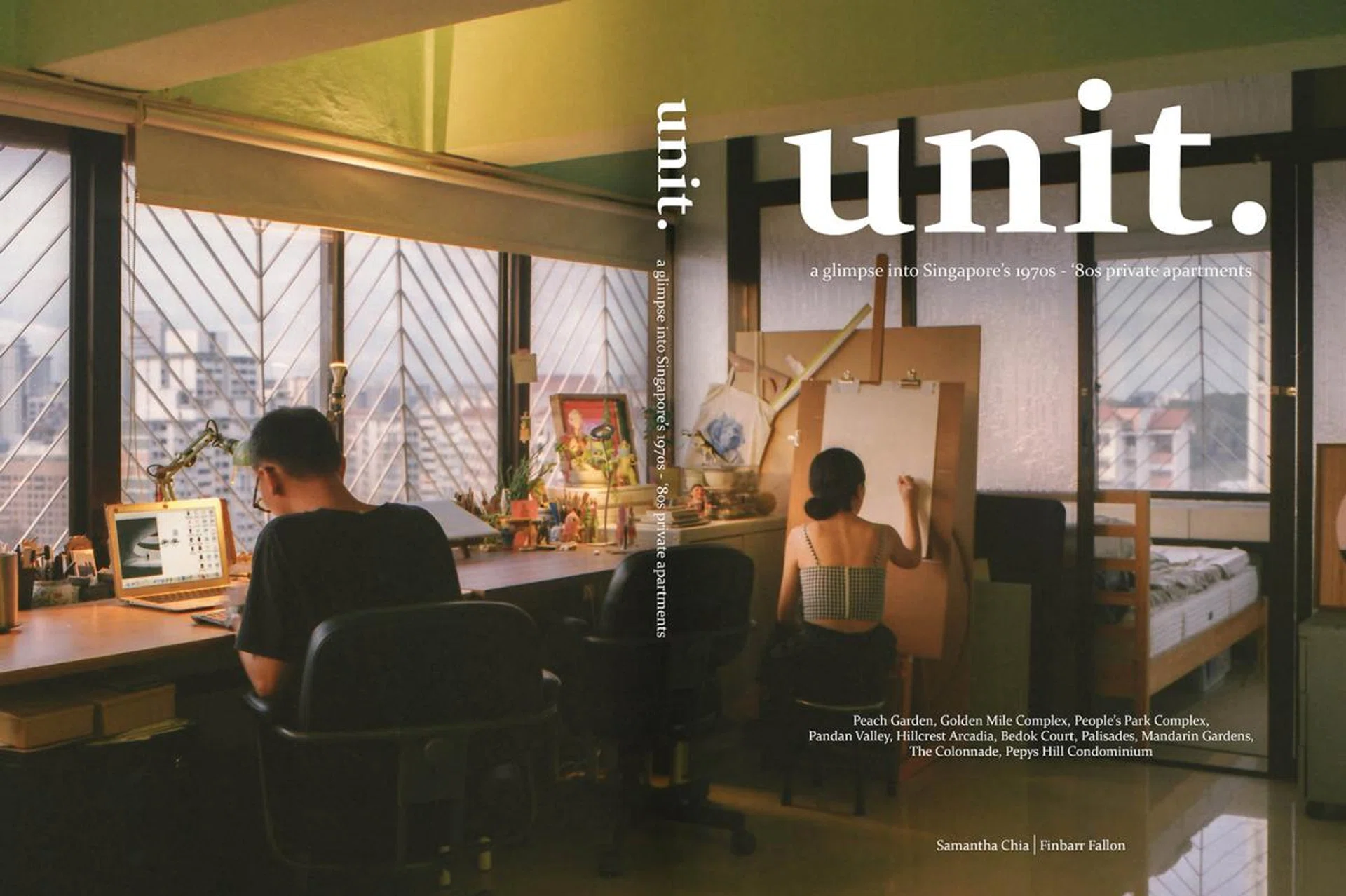
What is home? It’s a question that’s only grown in weight and complexity since the start of the pandemic. It’s also one that lies latent within the pages of Singapore-based British architectural photographer, visual artist and designer Finbarr Fallon’s latest project: a 224-page book co-authored with urban planner Samantha Chia titled UNIT. a glimpse into Singapore’s 1970s–’80s private apartments.
Released at the end of July, the self-funded publication features 10 households in 10 different private high-rise developments built at a time when the nation was grappling with land scarcity, yet landed property was socially regarded as the criterion for exclusivity and affluence. These include Golden Mile Complex; Pandan Valley, one of Singapore’s first condominium concepts completed in 1978; and the charming Palisades in Pasir Panjang with its idiosyncratic funicular lift.
READ MORE: We Travelled Around Singapore For The Best #SGArchitecture For This Fashion Story
“Architects back then were trying to define what attractive high-rise living should look like and, to some extent, how they would represent Singapore’s ambitions as a modern nation,” explains Fallon. “Unlike today, living in a high-rise was a relatively uncommon experience.”
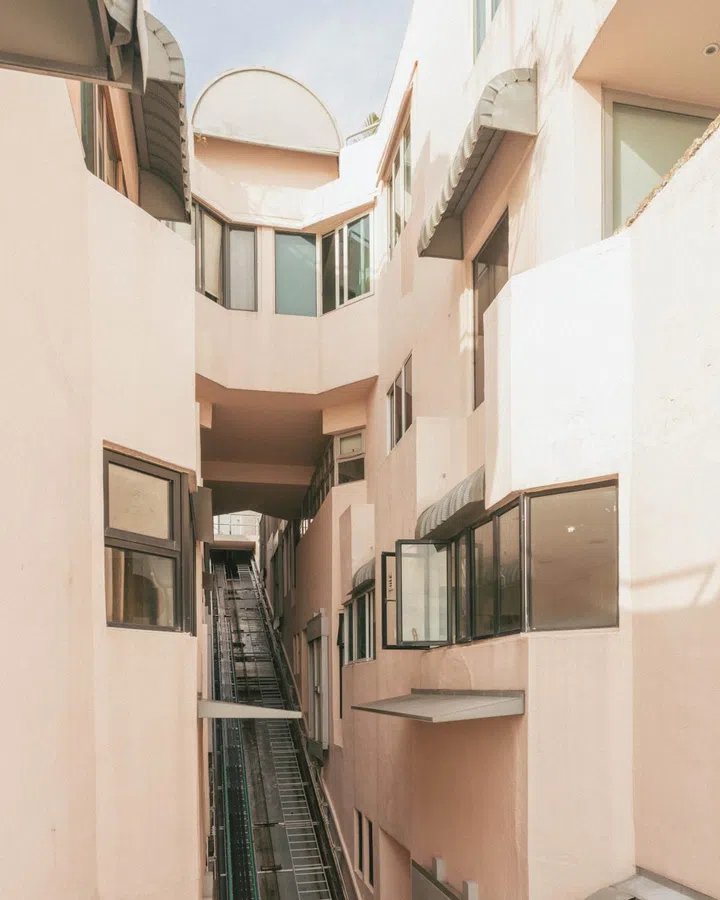
The charming pink-hued Palisades with its one-of-a-kind funicular lift – a development built in 1985 and located in Pasir Panjang – is one of 10 private apartments featured in architectural photographer Finbarr Fallon’s book UNIT. a glimpse into Singapore’s 1970s–’80s private apartments.
For the uninitiated, the 30-year-old has been based here since 2016 (he met his now-wife – a Singaporean – at university in London and followed her when she moved back for work). In person, the architecture-trained multi-hyphenate (he does photography, film, and both physical and digital installations) is soft-spoken yet steady, a largely pensive figure with a hint of playfulness.
READ MORE: Biophilic Design And Architecture Reacquaint Us With Nature
Even with his commercial commissions, he’s come to be known for infusing his architecture-led images of spaces with a certain gossamer veil of delicacy. The effect is such that familiar monolithic structures take on a romantic, softened aura. Despite their striking shapes and lines, they come across as characters set in a mystic land. See Fallon’s portrayals of, say, the water storage tanks that resemble spinning tops off Tampines Road, or the trilobite-esque Flower Dome at Gardens by the Bay, on his personal Instagram account @fin.barr. Even the seemingly mundane – such as elevated MRT tracks in mid-construction – takes on a serene majesty.
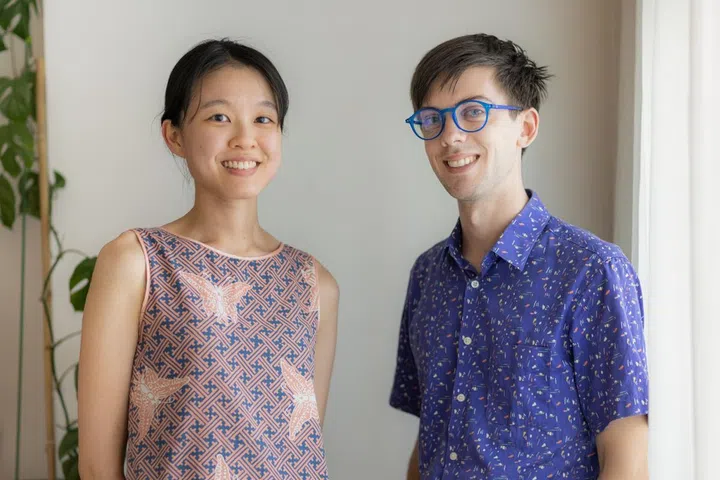
British architectural photographer, visual artist and designer Finbarr Fallon (right) co-authored the 224-page UNIT. with urban planner Samantha Chia (left).
This all makes UNIT. even more fascinating because instead of capturing a building from the outside or afar, he – for the first time – gets truly up close and personal. Besides pictures of lived-in residences shot in his cinematic style, there are plain-spoken interviews with their inhabitants. “The idea of documenting these buildings through the unit-level, lived experience was prompted by our experience of living through the pandemic, or more specifically the Circuit Breaker in 2020,” says Fallon. “We were spending every day confined to our apartments. That made us ruminate on what it meant to be ‘at home’. What does the home mean and how important is an apartment’s interior in defining this?”
READ MORE: Architect Amanda Gunawan On How Design Affects The Dining Experience
Even though he’s lived in this adopted country for more than half a decade (he’s a permanent resident) and immortalises dwellings as part of his profession, these are topics even he finds difficult to unpack. Like the most sensitive of bystanders, his perspective is gleaned from what he’s learnt through seeing how others live.
“From interactions with my family and friends here, material culture seems to be a very important anchor to their sense of Singapore as home. Food, obviously, is a key example, but I find that people also feel very passionately about the built environment, and are proud of the quality of greenery and public housing. But I also find it interesting that Singaporeans are very reflexive about their national pride. There’s a constant sense of ‘Okay, but what could and should Singapore do more of, and better in?’”
“When photographing, I consciously adopt a process of slow observation to seek out compositions that capture the form in unusual ways, including repeat visits at different times of day. In my spatial storytelling, I’m interested in how one can capture or evoke a sense of atmosphere through use of scale, sightlines, shadow, colour and so on. I often shoot with longer lenses rather than a wide-angle lens, as I like to show close-up views that people may not have noticed, even if they walk past the building every day – views where you can really feel the mass of the building, and see every material detail or imperfection with clarity. My favourite time of day to shoot is during the golden hour, as the light is softer and warmer, and I can leverage the long shadows to more dramatic effect. Shooting towards the sun with low sunlight filtering between trees, one can achieve an almost painterly glow. There’s great visual texture created by the dappled shadows that mature trees cast against buildings or on the pavement.
I am also always ready to run out the door to take pictures when a storm blows in – the NEA’s (National Environment Agency’s) myENV app is one of the most-used apps on my phone! I love the atmospherics of tropical rain – the sheer intensity of it combined with a subtle backlight produces a very beautiful soft light while turning the city into silhouettes...To level up my rain-preparedness, I recently bought an orange Burberry sou’wester hat and I’m excited to use it on my next rain outing!”
“As someone interested in liminal urban spaces, I did a lot of urban exploration, known as ‘urbex’ in London, visiting abandoned or derelict sites, and large infrastructure projects. By virtue of geography and land scarcity, there are just less of such spaces here. I would also rather not run afoul of the law here so that has curtailed my urbex efforts, but this in fact pushes me to really hunt for interesting spaces or explore new ways of shooting. The kind of rain in Singapore is also very different from the kind we get in the UK. Tropical rain is often sudden, intense and fleeting. This is challenging from a commercial architectural photography point of view, because clients want blue-sky shots so I often have to cater back-up days for shoots. But I personally love the contrast between the soft luminosity and sense of stillness created by the sheeting rain, and the otherwise hard-edged cityscape and people scrambling to escape the downpour.”
“The intertidal zones along the coastline in the early morning can be peacefully idyllic. Besides the chance to see some fascinating wildlife, people are also always very friendly and that sense of camaraderie is refreshing. Otherwise, I can often be found in industrial areas on weekends (pictured above is a shot from Fallon's fashion editorial debut for FEMALE's August 2022 edition, taken at the edge of an industrial site in the Pioneer District). The contrast offered by these low-density yet large-scale developments feels very unlike Singapore and I enjoy the oft-unexpected sights from examples of makeshift creativity that dot this less manicured landscape.”
“Many of these ’70s and ’80s apartments have been frequently photographed from the outside, but we rarely get a glimpse of what they look like on the inside or how the spaces are used today… We thought that understanding these buildings, which were considered innovative at the time, through the perspectives of their residents would give us insight into how they translate to the experience of the home and if the ideas that the original architects had in the past still resonate today.”
“Singapore’s buildings and urban structures tell very fascinating stories of its socioeconomic history, and private high-rise apartments that were built during this time period are a particularly good example. As a young, post-independence nation grappling with land scarcity, Singapore was looking to move its population away from landed and low-rise living into high-density housing. Architects back then were trying to define what attractive high-rise living should look like... I also found the contrast between Singapore’s large-scale push to go high-rise, and the UK’s waning fascination with modernist, high-rise housing taking place over roughly the same period, fascinating. Modernist housing estates in the UK evoke mixed reactions even today, but I’ve always loved their form and materiality, and respect how conscientious the architects were in designing projects that were thought to espouse the ideals of social mobility and a common good.”
“I appreciated very much the generosity of strangers in letting us into their homes and spending time to talk about the experience of living there. We were genuinely concerned that we would hit a dead end finding people to talk to. (Fallon and Chia depended on friends’ contacts, cold calls and social media.) Time aside, the home is also an intensely private realm so it was a real privilege to hear people’s stories and be permitted to photograph their spaces. It was interesting to look at how everyone’s experience living at home through the pandemic was universal yet personal. There were common things that everyone talked about, such as making adjustments to their homes to accommodate everyone working from home, or how things like open spaces around their apartments took on a new importance, or making changes to regular hosting activities – no more large groups! And then there were really specific responses, such as the couple who adopted a bird during the pandemic, which is happily living in their balcony now.
It wasn’t intentional, but in a way the book reflects the strange times that we lived in and are still living in during the pandemic. What I like is how it also shows that despite the apartments being built decades ago, there’s a certain longevity and almost timelessness about the attributes that people value about them. And to me, the thoughtfulness of the design really comes through in how the apartment is still fit for purpose as a home even under very different circumstances, and the pressures of these exceptional times we are living through.”
“Greater awareness and appreciation of older buildings in our cityscape and the stories they can tell us. I felt that going through the process of making this book really emphasised the importance of designing and innovating, with local context and climate in mind. In a project like the Colonnade, for instance, the architect Paul Rudolph had really thought about the relationship between the bedroom and the living spaces, and how they should be configured to ensure one was shielded from the harsh glare of the sun. At the same time, I think the book explores how design that’s attuned to national ambition as well as the local context can come together, in the domesticity of how people actually live at home. The interviews really showed how individuals and residents have considerable agency to shape their surroundings, and sometimes the outcome may not always adhere to what the architect envisioned. The eclectic facade of the units at Golden Mile Complex is a good example of that, or the fact that many Bedok Court residents had installed fences for privacy at their terraces, which ran counter to what the architects had envisioned with the staggered design!”
“For my wife and me, it was important that our HDB flat has an abundance of light, a good view, and an interesting site context. Our unit has quite an elongated layout, with a larger number of window panels than the norm. Our unit overlooks low-density conserved buildings so it’s interesting to look out at the street life teeming below but, at the same time, it’s lovely to be able to see the golden light gleaming off skyscrapers in the distance.”
A version of this article first appeared in the August 2022 Home Edition of FEMALE