
Ashley Chin Wants To Talk About Singapore’s Ghosts
Singapore’s creative pulse isn’t waiting for permission. Across studios, stages and unexpected corners of the city, a new wave of young makers is building in real time, guided less by old formulas than by passion, instinct and a genuine curiosity to do things differently. Here, we speak to anthropologist-in-training Ashley Chin, the semi-viral ghost girl who’s investigating the role of the supernatural in modern Singapore.
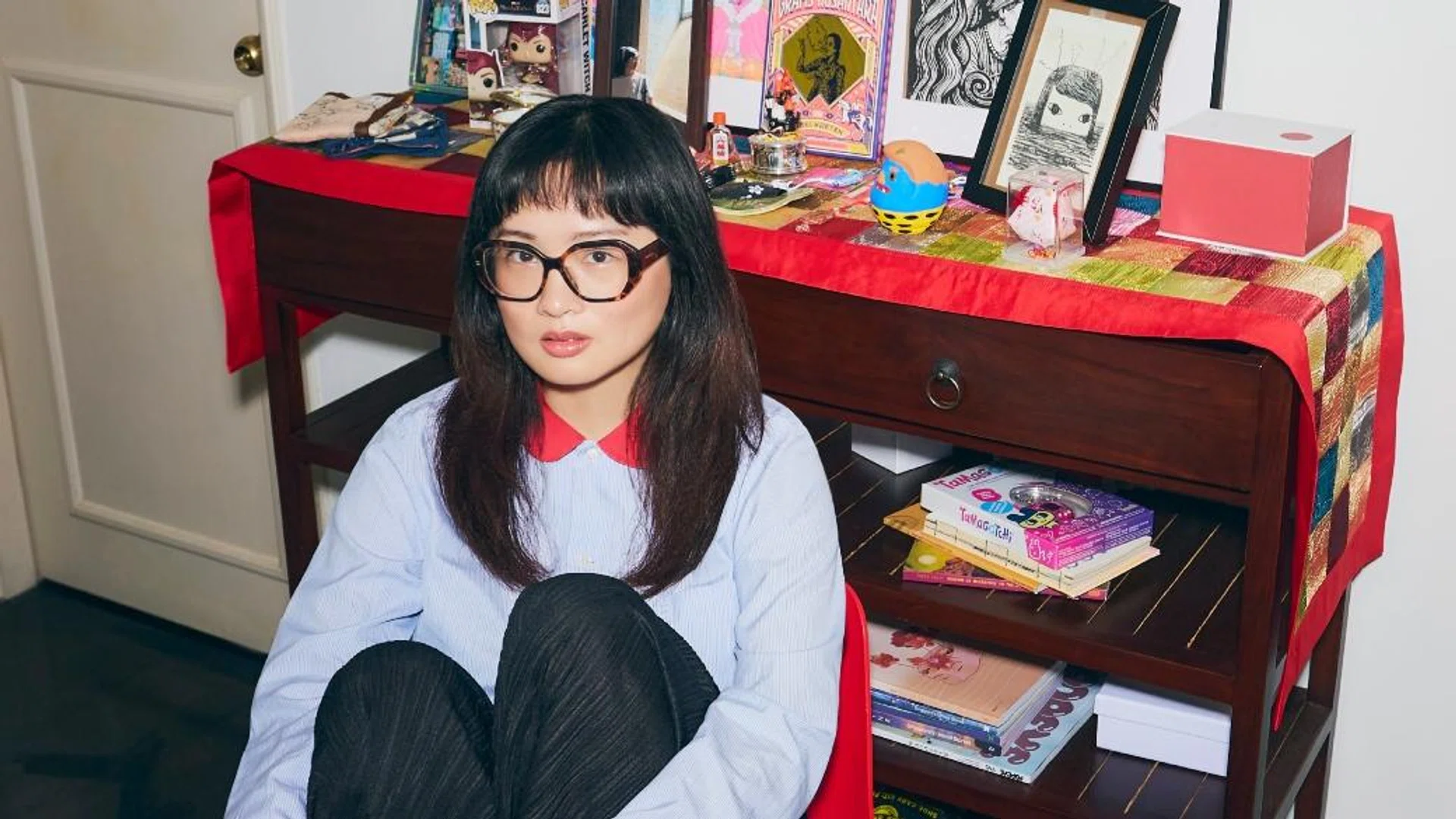
Knowledge influencers – creators whose content is more about facts than, erm, fluff – are getting their much overdue turn in the spotlight and few are as intriguing as Ashley Chin, a recent Cambridge anthropology graduate.
She first went viral last Halloween during an interview on campus about her unusual master’s thesis, which explores the role of the supernatural in contemporary Singapore. Ghost stories, she posits, let people hold on to what has been lost amidst Singapore’s relentless march to modernity, linking us to our past and our fears – and sometimes without us noticing.
Capitalising on her viral moment, Chin set up the TikTok account @sigandfranz to bring her anthropology‑based point of view to social media. Those interested in her thesis will have to wait a while for it to hit her page: It’s being made into an academic journal article, which means it has to stay under lock and key until publication.

In the meantime, she’s creating content that brings her audiences along to indie events and creative happenings in Singapore, or – as she puts it – she’s translating an anthropologist’s field notes for our social‑media‑addled brains.
Expect anything from deep dives into obscure films to tours of cultural spaces such as ArCH Square, an education and outreach centre opened last November that’s dedicated to archaeology and intangible cultural heritage – reportedly the first of its kind here. “Academia has a responsibility to attend to the world’s problems,” she quips – and we’re all the better for it.
Ashley! What first drew you to anthropology?
“Fun fact: I went to university thinking I would be a literature major. I’ve always found my life very ordinary, and I’d grown up with people with very similar backgrounds and very similar paths: upper middle class Chinese kids destined to become yuppies. I’d always been really unsettled by the ennui of living that life and at the time, English lit was my only portal to reading the lives of other people, even if imagined, from another time and place.
I went to Yale-NUS college for my undergrad where it was administratively very easy to change majors, and basically had an existential crisis about what I was doing with my life, and a minor crisis about what literary criticism really ‘did’ in the world, so I jumped to anthropology where I felt like I could continue with the existentialist concerns about living and being but with ‘real’ people. The first ethnography I read blew my mind: it’s Given to the Goddess by Lucina Ramberg, on the contested lives of the devadasi—women married to the goddess Yellamma—in Southern India.”
What made you land on the topic of ghost stories in Singapore for your dissertation in the first place?
“It’s a long story of general interests getting narrower and more specialised over time. I first became interested in the anthropology of religion when I was taking a class in the anthropology of technology. I expected tech to be where all the exciting, boundary-pushing ideas were happening, but I kept noticing that the most cutting-edge, mind-blowing work was actually happening in the anthropology of religion — exploring how people experience belief, the unseen, and the limits of the rational.
From there, I was researching speaking in tongues and Charismatic churches in Singapore for my honours thesis, and once everyone knew I was researching religion, all the ghost stories came tumbling out.
By the time I got to pitching my master’s in my supervisor’s office halfway around the world, the distance gave me space to come up with a really Singaporean knot — a kind of puzzle anthropology could unravel. And I thought about Russell Lee (the moniker of the authors behind True Singapore Ghost Stories, the popular book series in Singapore that has been running since 1989) and all the ghost stories I’d been told through the years, even before I discovered anthropology — that there is a reservoir of ghost stories in spite of people’s religious identities or commitments.
I thought the master’s would be the end of the road for me in academia, so I thought, “ah, that would be a great puzzle to solve.” Something I’d feel really proud of myself for tackling before I have to give this up for good and “get a real job”.”
Why do you think ghost stories still resonate so deeply in such a hyper-modern, rational city like Singapore?
“I think any armchair observer would say that every culture has its ‘folk tales’ it tells its children, and that ghost stories are just part of Singapore’s cultural fabric. That’s not wrong, but it’s only scratching the surface. Stories are never just stories.
You would think that ghost stories exist on the very margins of modernity: the last bastions of the past. But what I found was that ghost stories were very much a necessary part of being modern and being rational. Because being modern and rational is never simple or straightforward: it’s more often than not a constant negotiation. Ghost stories enable modern Singaporeans to talk about spine-chilling encounters at the limits of empirical reason without being seen as ‘crazy’ or ‘naïve’: the footprints heading towards you, your name whispered on a deserted road. You can describe events as they happen and imply the ghost without going out and saying, “I definitely saw a ghost.”
You’ve said ghost stories help people talk about things they otherwise can’t. What do you think they allow us to say?
“On the level of the individual, ghost stories allow us to say things in spite of ourselves: just by having a listener to vent to, we get to purge that gnawing feeling you’re left with after an encounter. But when ghost stories become a cultural lexicon and are broadcast as Pontianak films or horror stories, they additionally become vessels through which certain anxieties or identities are articulated in their time: decolonial identities of being Malayan, or post-development anxieties about articulating what it means to be Singaporean in the face of rapid change.”
What surprised you the most while researching the history of ghost stories in Singapore?
“Did you know our newspapers used to report on ghosts? This one’s my favourite headline that made me chuckle: ‘MALAY FIGHTS GHOST IN GEYLANG - The Singapore Free Press, 23 January 1950, Page 5’. It follows an elderly Malay clerk in Geylang, Inche Omar bin Haji Ismail, and his fight to rid his house of a poltergeist. He hires a dukun (a Javanese healer) to exorcise the poltergeist with a pierced lemon, but as soon as he throws it out of the house, it bounces right back in. They interview Inche Omar and report that “the housing problem in Singapore has made him more determined not to quit.’
It’s significant that these ‘ghost reports’ appeared in the fifties, as decolonial dreams of a ‘Malaya’ were brewing and the English-language press was passing into Singaporean hands. These are local events a Singaporean-minded press felt were newsworthy and necessary to circulate to an emerging Singaporean public.”
What made you decide to bring anthropology onto TikTok?
“Since my undergrad days, I’ve been bothered by the gulf between academia and the public. To me, academia has a responsibility to attend to the world’s problems.
Honestly, bringing anthropology onto TikTok was a little opportunistic: I turned my five seconds of fame from that semi-viral interview with my dad into a platform. I think people want me to put out a lot of educational content, but that’s putting the cart before the horse — or the medium before the message.
TikTok rewards a certain format and quantity, and I try to hold steadfast to my own reasons for being online: that I have something to say in a larger conversation. There’s an essay by Matt Greene on LitHub, “On the Rise of ChatGPT and the Industrialisation of the Post-Meaning World”, in which he, as a writer with an eye to communication, talks about how language in this saturated post-meaning world tastes like an “oily, filmy coating” of nothing.
So much content online is AI slop — or megabytes of data that say very little. Being a holdout to a more intentional form of communication feels like (and I’m borrowing from Greene here) “being a vegan at a barbecue in 1998.”
We’re seeing a greater focus o creators who are known for their knowledge-based content. Why do you think knowledge-based content creators seem to be rising in popularity?
“Knowledge-based content creators have been around for a hot minute: think Nat Geo documentaries on TV, or the Green brothers and their CrashCourse YouTube channel, or Instagram infographics. It just feels new to short-form video (TikTok and IG Reels).
I have a few suspicions: so much content online feels ‘empty’ — we’re all concerned about ‘brain rot’ from a media diet of nothingness — and the allure of knowledge-based content is the promise of ‘feeling good’ about our online addictions, that six hours into a doomscroll we’ve ‘learned’ something.
And this is against a backdrop where people have been turning away from earlier avenues of learning: Netflix has taken over TV channels (goodbye Nat Geo and History Channel), TikTok over YouTube, and people aren’t reading as much as before, when they might pick up a 200-page book on a subject.
Another factor is that so many content creators are essentially peer consumers. Think of the original Michelle Phan in the beauty influencer space — the appeal was twofold: first, as fellow consumers, they gave brutally honest product reviews; second, ordinary non-celebrities could still look glamorous with a little makeup skill, which is the charm of tutorials.
I think people are growing tired of so many peer-consumer opinions and are seeking the perspectives of actual makers, specialists and producers — for example, beauty cosmetic formulation with Lipstick Lesbians, or urban history with Yong at Young Urbanists.”
What other plans might you have for this year?
“I’m hoping to get my driver’s license before my account expires. I don’t want to pay to extend it. If I pass the practical on my first attempt, everyone’s going to hear about it from me. I’m also preparing my PhD application so fingers crossed!”
PHOTOGRAPHY ISABELLE SEAH ART DIRECTION JONATHAN CHIA
HAIR TAN ENG CHONG/KIZUKI+LIM MAKEUP SARAH TAN
An adapted version of this article first appeared in Volume 7 of F ZINE.