
What Happens When Four Artists Take On Bottega Veneta Bags?
From sculpture and nails to ikebana and painting, four Singapore artists turn Bottega Veneta’s iconic leather craft into playful, textural works of art, proving that curiosity travels across mediums.
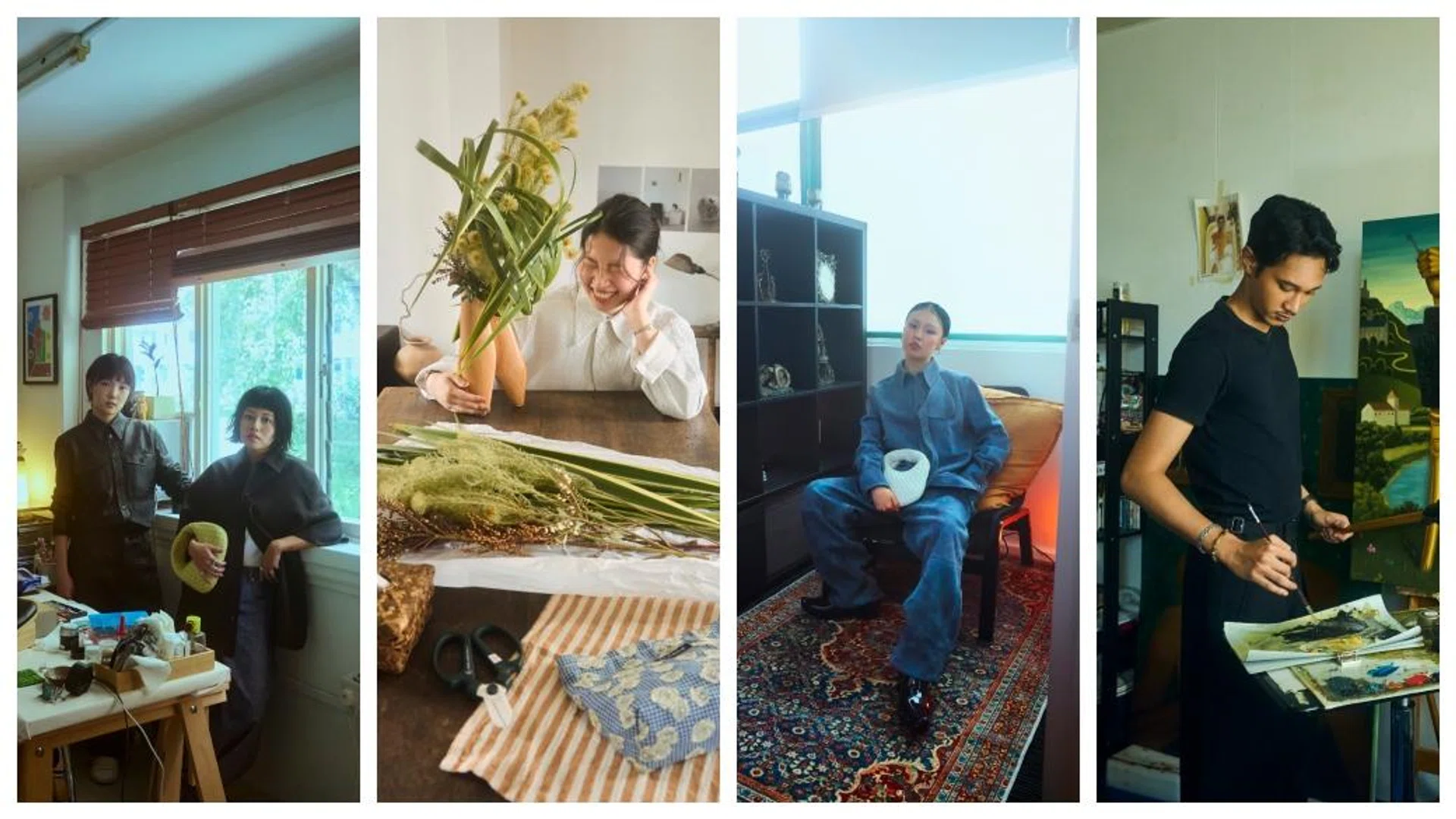
“Craft” is one of those words fashion loves to throw around. For artists, though, it isn’t a mythical buzzword; it’s simply part and parcel of the process of making. The attention paid to texture, tension, and touch. The many long and sometimes frustrating hours spent repeating gestures over and over.
Bottega Veneta embodies this ethos perfectly. After all, this is the brand that can be recognised instantly not by a logo, but by the intrecciato (say in-treh-chah-toh — it’s Italian for braided or woven), a weaving technique the Italian house created in 1975, where strips of leather are threaded diagonally to create a lattice that’s both soft and flexible.
The weave says a lot about how the brand thinks about craft. You see, at the heart of Bottega Veneta is a simple belief: Craft isn’t just about technique, but the meeting of hand and mind, and it’s aptly summed up in its motto of Labor et Ingenium (Latin for labour and ingenuity).
To explore this idea in new ways, F ZINE – with the support of Bottega Veneta – invited four Singapore-based artists to pick one of the house’s leather bags (the elegant Andiamo top-handle, the sculptural Baby Veneta clutch, and the sleek Barbara tote) and get inspired by it.
Rather than treating the bags as finished luxury objects, the artists approached them as they would any material in their studios — as starting points for experimentation and play. Here’s a closer look at how each exchange unfolded:
PART TIME NAILS
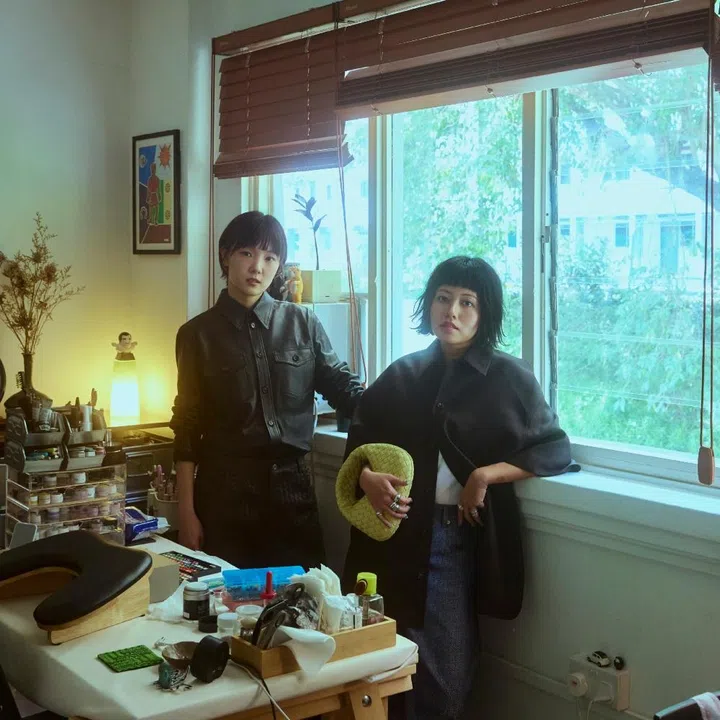
Part Time Nails co-founders Yi Lu (left) and Edna Sun (right). Yi Lu wears nappa leather shirt, and Intrecciato leather pants. Sun wears wool silk toile shirt, cotton wool twill pants, and Baby Veneta leather top-handle bag, all Bottega Veneta. All other accessories, artists’ own
At Part Time Nails, Singapore-based duo Edna Sun and Yi Lu turn nails into miniature art canvases. Sun, a graphic designer, and Yi Lu, trained in fashion and luxury communications, launched Part Time Nails in 2025 as a side project to explore creativity beyond their day jobs. Their work blends texture, colour, and sculptural detail, translating inspirations from ceramics, contemporary art, and fashion into playful, wearable artworks. Each set is handcrafted, moodboard-driven, and unique, reflecting the duo’s belief that nails can be both intimate expression and a bridge between disciplines.
Hi guys! What was your immediate reaction when you first encountered the Baby Veneta?
Yi Lu (YL): “At first, the Baby Veneta felt almost like a small sculpture. It just sits there so nicely on its own. But the moment I picked it up, what really got me was how soft it felt. The padded leather makes such a difference. I’m a very tactile person, so I kept touching and pressing it. It’s one of those pieces that makes you want to interact with it, not just look at it.”
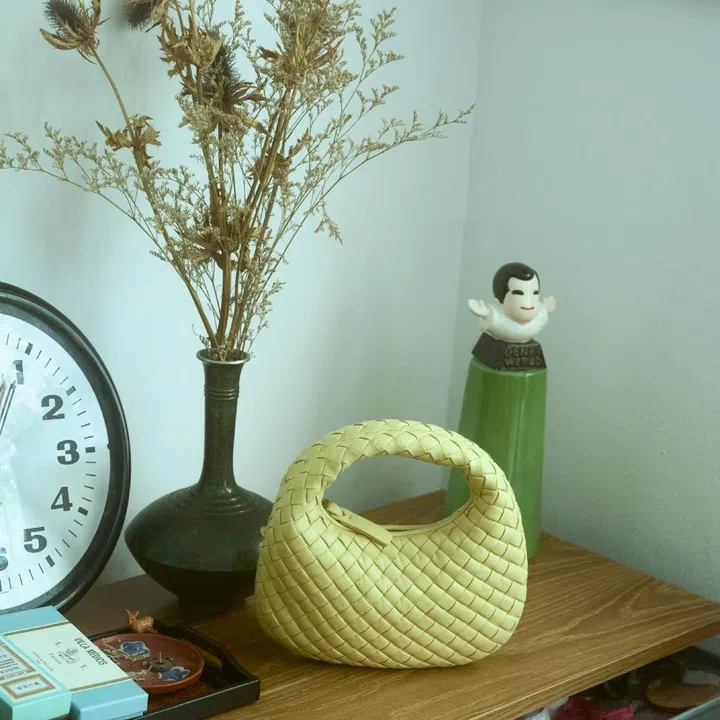
The Bottega Veneta Baby Veneta bag. This XS version is the latest update to the brand’s classic 2002 bag of the same name, and it now features the intrecciato weave in a slightly more padded finish and comes in ultra-soft nappa leather.
Was there a particular detail about the bag that spoke to you?
YL: “Learning about Bottega Veneta’s intrecciato technique and how it’s constructed really stood out, especially the 45-degree bias cut (where the leather strips are cut diagonally to give flexibility and ease in weaving, helping the bag stay soft yet structured). Back in fashion school, I learnt how cutting fabric on the bias gives it natural stretch and movement. Seeing that idea applied to leather felt quite special. The weaving strengthens the bag, but it still stays soft and flexible. That balance between structure and movement really resonated with me.”
Can you tell us how your artwork relates to the Baby Veneta bag?
YL: “We didn’t want to recreate the bag in a literal way. Instead, we focused on the idea behind Bottega Veneta’s signature intrecciato technique. We extended that weaving concept into our mood board process. For each nail, we layered the brand’s Spring/Summer 2026 campaign visuals together with images of the Baby Veneta, weaving them into a single reference. These layered compositions became our starting point.
From there, we translated what we saw into sculptural gel forms. Rather than copying the leather weave directly, we abstracted it into raised shapes that move across the nail surface, alluding to the bag’s softness, texture, and structure.”
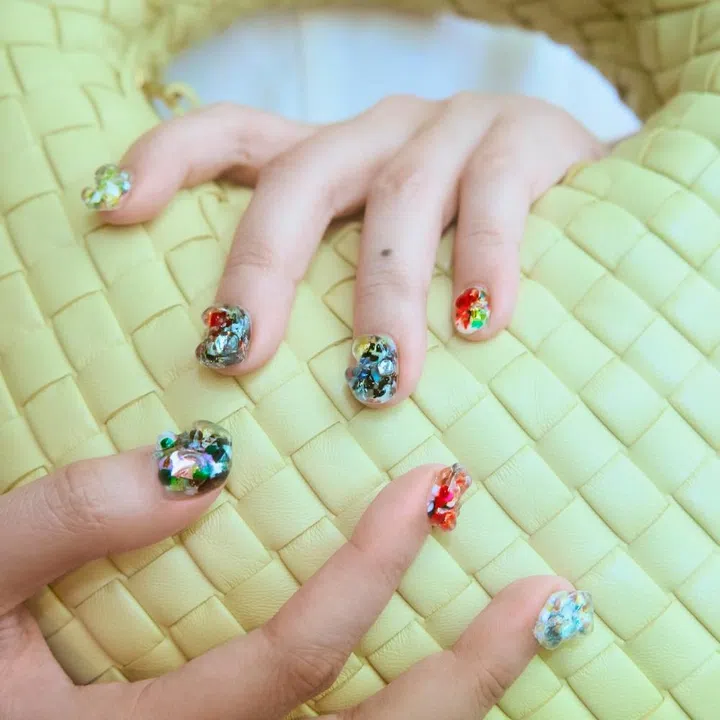
The duo’s nail art meets the real thing
Craft often brings to mind a rustic image - what’s your take on that?
Edna Sun (ES): “Sometimes craft gets framed as something very serious or proper. But to us, it can also be simple — using your hands to make something you care about, something you’re excited by. It’s about exploring, experimenting and enjoying the process.”
How has your understanding of craft evolved over the years?
ES: “We’re seeing a shift towards working across mediums and disciplines. Craft today feels less about repeating one skill over and over, and more about understanding different materials, contexts and ways of making. It’s about adapting and responding to how the world is changing, rather than staying fixed in one form.”
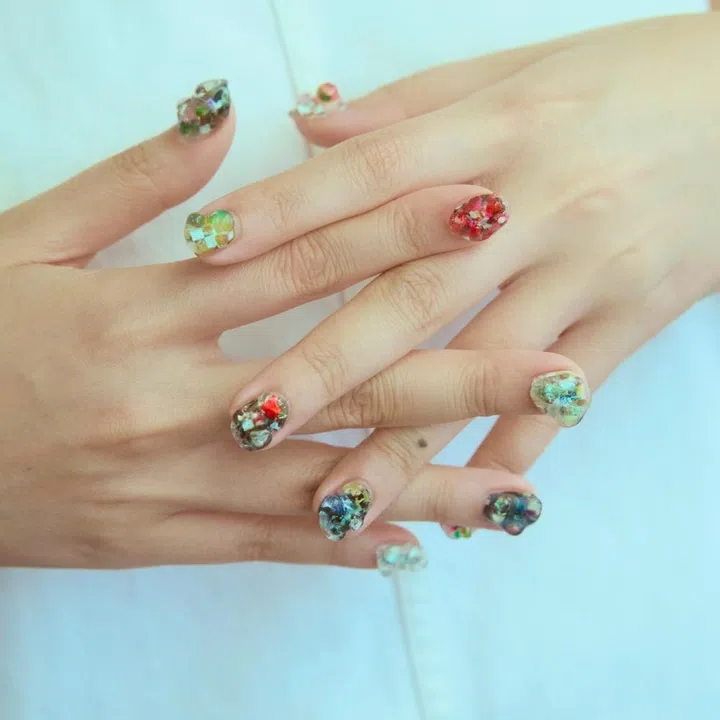
The duo’s abtract take on the brand’s intrecciato weave
What do you hope people take away from the work you’ve created for this project?
YL: “That material language can travel across mediums: leather becomes gel, an accessory becomes a gesture, a weave becomes movement. Inspiration doesn’t need to be literal to be understood.”
ISRAFIL RIDHWAN
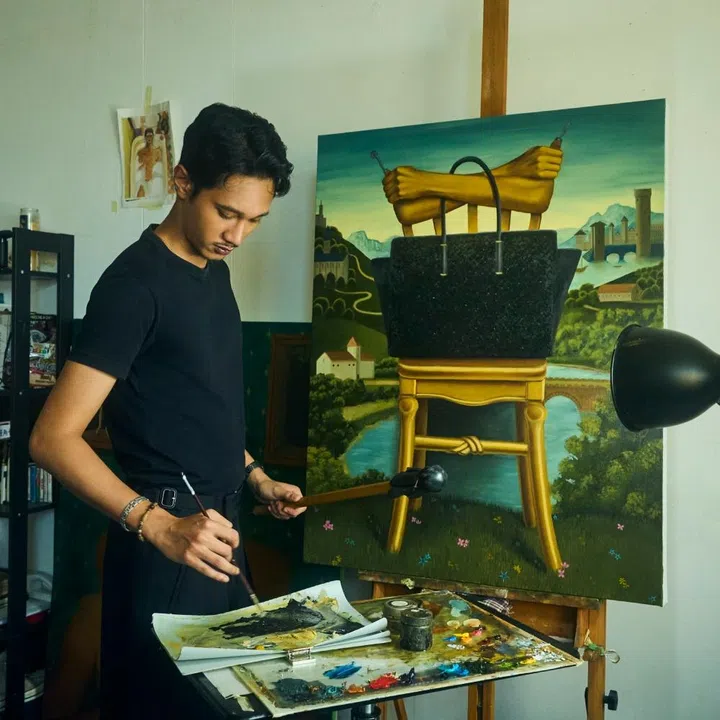
Artist Israfil Ridhwan. Israfil wears wool twill pants, Bottega Veneta. All other accessories, artist’s own
This 26-year-old paints like he’s directing his own mini movies — intimate, cinematic scenes full of colour, light, and drama. His oil paintings mix personal moments, queer narratives, and nods to art history, from Caravaggio to Frida Kahlo, all seen through his own lens of desire, heartbreak, and self-reflection. Despite early pushback in art school, he stuck with painting, crafting a world that’s equally lush in colour as it is in feeling. With four solo shows under his belt, including one last year at Art Paris, he’s fast becoming one of Singapore’s most compelling young painters right now.
Hey Israfil. What first drew you to painting?
“I’ve loved art since I was a kid. My first introduction to visual art was Frida Kahlo — the way she described her pain, how she viewed life, and the colours she surrounded herself with. I knew I wanted to pursue it professionally right after secondary school. I didn’t do well in art as a subject in secondary school, and that really ticked me off. Why did something I loved not give me the results I wanted? But I was a stubborn teenager, and against my parents’ wishes, I paid my own way through art school. Years of stubbornness are what made my craft what it is today.”
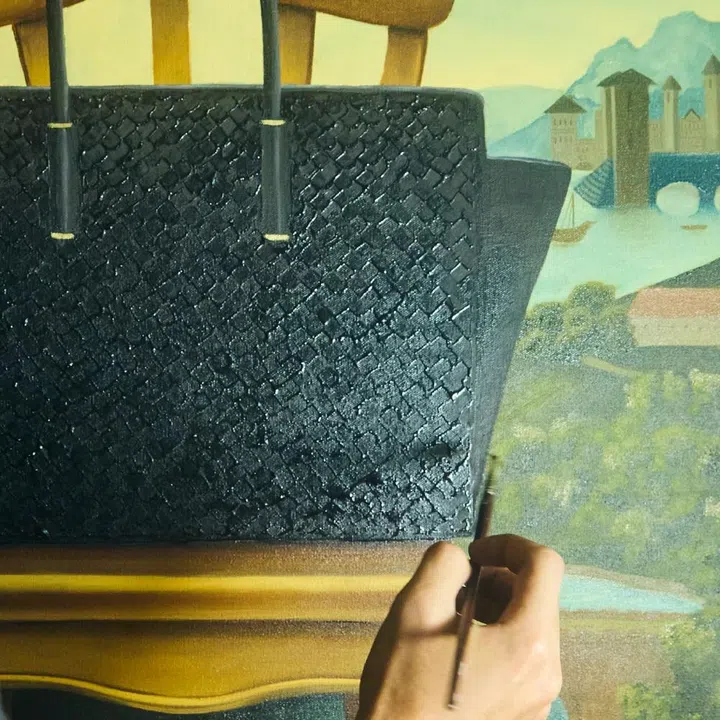
Captured in the midst of creating the artwork for this project
What’s the most difficult part of your practice that people rarely see?
“That it requires time. Time alone with your thoughts. Time that you may or may not have. Sometimes it feels like you’re running out of time because the world moves at a pace you have to keep up with. I struggle with that. There are days when I spend time in the studio doing nothing because I feel physically restrained. Creatives call it artist’s block, and it is—but for me, it also has a lot to do with the fear of messing up. My best friend always tells me it’s good to take breaks now and then—to let my mind and body rest, and to find inspiration from doing nothing.”
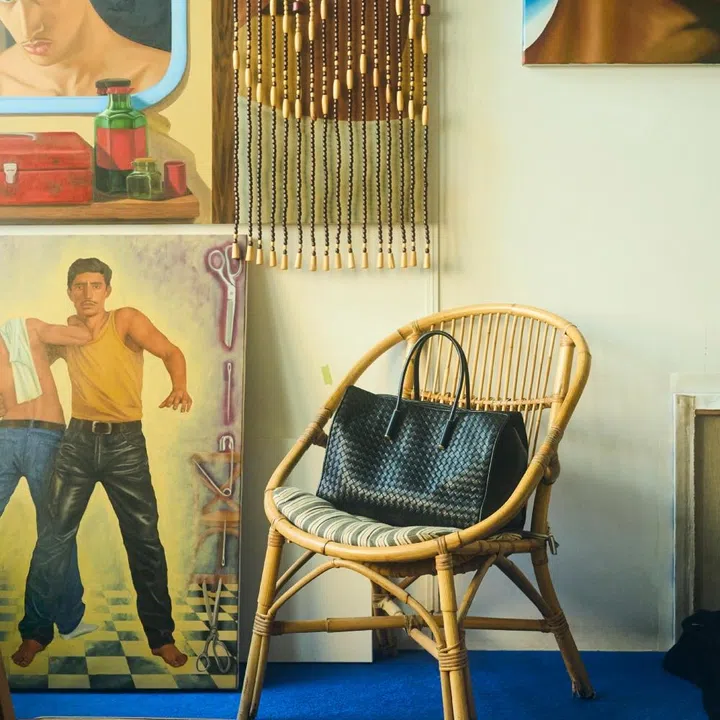
Israfil’s pick was the Bottega Veneta Barbara tote bag. A brand new number that debuted in the brand’s Spring Summer 2026 collection (the first under new creative director Louise Trotter), it’s the everyday-perfect tote that straddles workday practicality and understated luxury. The Barbara’s clean silhouette and thoughtful hardware (like that discreet zip and brass‑toned detail) give it a quiet confidence; a carry‑all that says “you look put together.”
After getting to know Bottega Veneta better, what about their craft stood out to you?
“During art school, many lecturers who didn’t paint tried to steer me away from it, saying I should prepare for a career where painting wasn’t the first choice. Looking at Bottega Veneta’s approach — honouring tradition while evolving — really resonated with me. Back then, I had limited studio time and had to balance classes and work, so I had to find my own way to keep practising. I chose to stick with painting, my medium of choice, even if it meant failing a class or two for not following the lesson plan. Sticking with what I believed in has brought me this far — and in a way, I see that same balance of respect and experimentation reflected in the brand’s craft.”
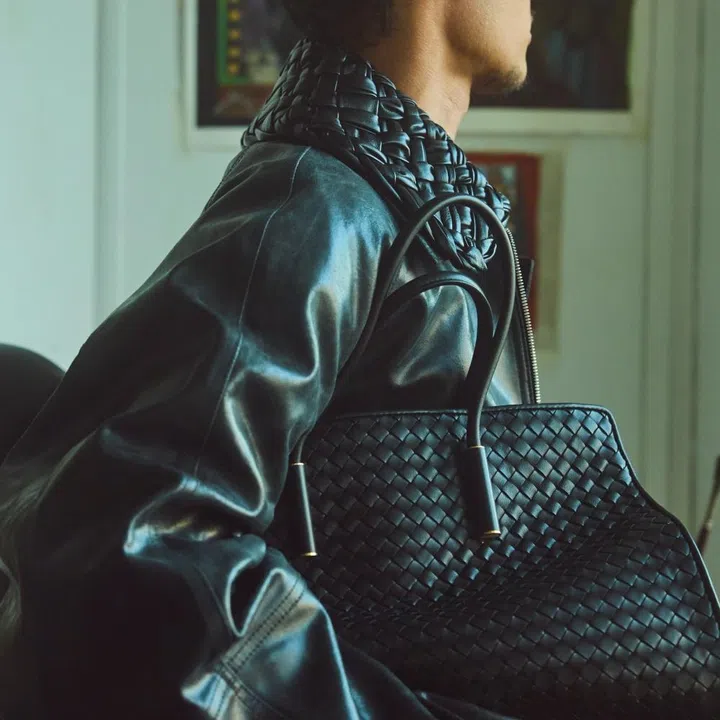
“I like that the Barbara is a solid, well-structured bag. I love when a bag gives that feeling; not flimsy, but sturdy — it has a certain weight to it that makes it feel luxurious,” says Israfil. Here, he wears leather blouson and Barbara leather tote bag, all Bottega Veneta
How did the Barbara tote bag or the brand itself inspire your piece?
“Nothing feels more Italian to me than a Renaissance landscape painting. I gave it a surrealist twist by adding a chair with arms and hands as the top rail, each hand holding an object—tools of craft used to make the bag. The crossed arms symbolise Bottega Veneta’s steadfast commitment to its values and craft, while the knot on the chair’s spindle alludes to the brand’s history, future, and dedication to Italian handcrafted luxury. The grass and wildflowers hint at renewal and fresh beginnings, especially with Louise Trotter now at the helm as the brand’s new creative director.”
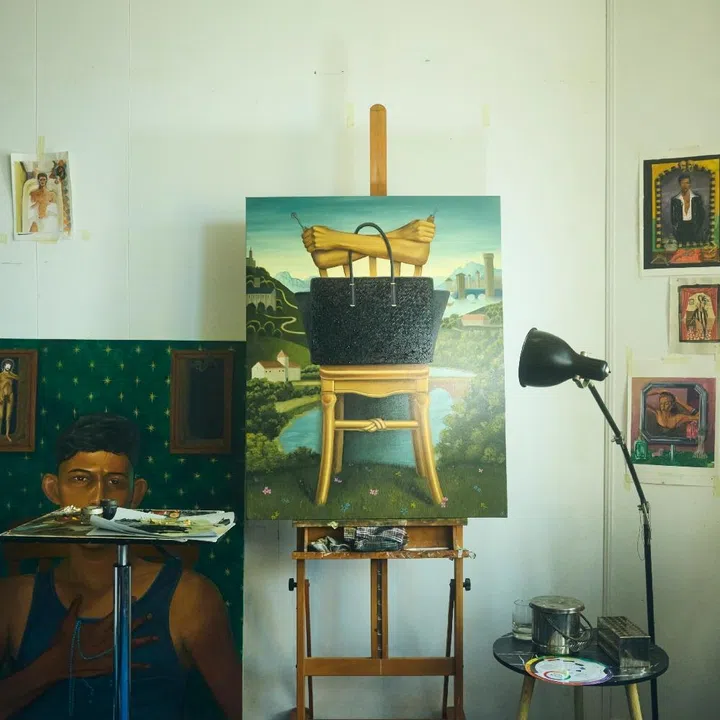
The painting (on easel) Israfil created for this project
What do you hope people take away from the work you’ve created for this project?
“Support the hands that make the things you love. Acknowledge their history, respect the care behind each gesture, and appreciate the nuance in every creation. The world moves fast, but it never hurts to slow down and celebrate the human touch that grounds us.”
HILARY YEO
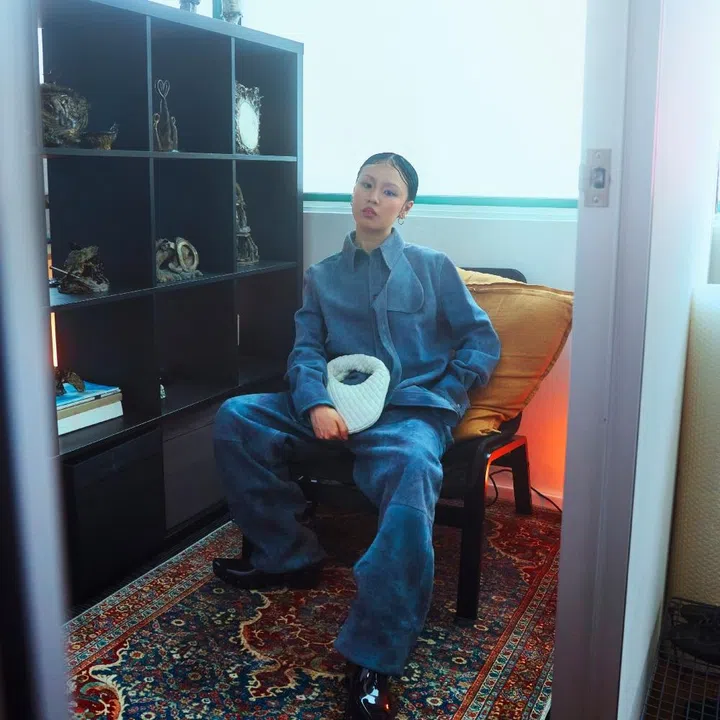
Artist Hilary Yeo. Yeo wears suede shirt, matching pants, Baby Veneta leather clutch, and Gondola rubber clogs, all Bottega Veneta. All other accessories, artist’s own
Hilary Yeo sculpts worlds, not just objects. Based in Singapore, she works in clay and ceramics, creating forms that feel alive, earthy and almost faerie-like — creatures in the middle of becoming. Material is her collaborator, holding traces of touch, memory, and desire. Her work has shown internationally, from Barcelona Art Fair to Singapore Art Week, and she’s shared her practice at the National Museum of Singapore and the Asian Film Archive.
Hi Hilary. How did you first get into ceramics?
“I was creating a lot of two-dimensional multimedia and tech-related work as an artist before the Covid-19 pandemic and the lockdowns, particularly with Pure Ever, a collective I was part of at the time. But with the explosion of tech and art around that time, and being right at the height of it, I became quite disenchanted with the medium, as well as with my own lived reality and the oversaturation of technology in my day-to-day life. Like many people, I picked up ceramics for fun and somehow ended up really falling in love with it. It gave me a sense of grounding and freedom, and a deep satisfaction in seeing something three-dimensional come to life.”
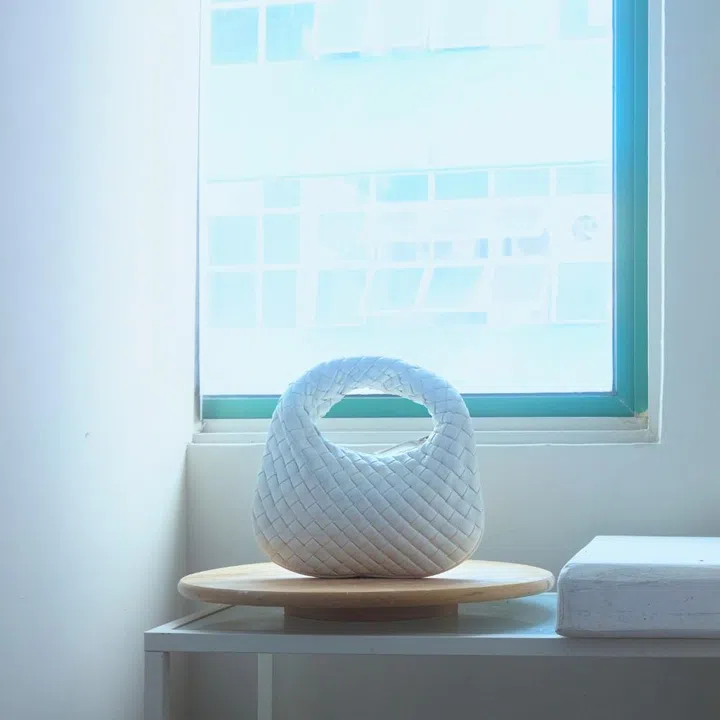
The Bottega Veneta Baby Veneta bag comes in five colours, including black, yellow (pictured earlier in the story), a cardinal red, brown, and this icy white version.
How did the Baby Veneta bag or the brand itself inspire your piece?
“I work primarily in ceramics and sculpture, so naturally, I wanted to create something in that medium. But other than the material, I didn’t really have any clue what I was going to create, so I picked the most literal thing as a starting point. The bag, or the holder of things, became a metaphor.
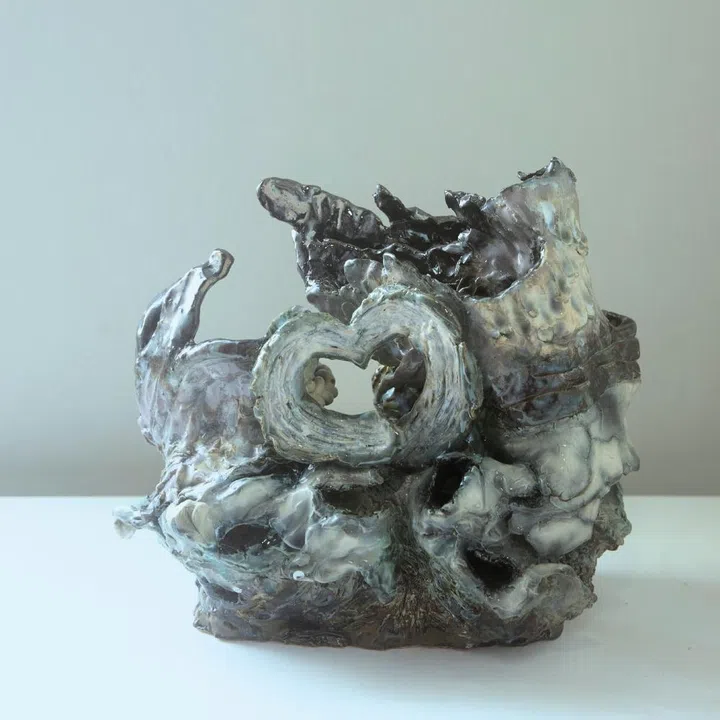
The sculpture Yeo created for this project transforms the Baby Veneta bag into a whimsical ceramic piece — at its centre is a heart-shaped detail inspired by the negative space between the bag’s handle and body.
The result is a piece that I have named Cradled by the Hands Of. At its centre is a heart-shaped detail that anchors the sculpture - this was inspired by the organic negative space between the Baby Veneta bag’s handle and its body. This heart-shaped detail is held up by two complementary structures joined at the base, which gradually diverge into hollow forms. As they rise, the two forms seem almost repelled from one another, yet they also appear to desperately want to reunite, as if reaching out to each other with growing wings or fingers.
I was also drawn to the movement and dimensionality created by the bag’s padded weave, which resembles the indentations I tend to build through repeated finger imprints in my sculptures. The weave produces a strong interplay of light and shadow, something I also emphasise in my work through surface texture and sculptural depth.”
Craft often makes people think of something rustic — but does it have to be that way? How do you define craft?
“I don’t mind that craft brings up a rustic image, but I’m not sure that means there should even be a separation between craft and art. Historically, that distinction has been used to undervalue craftspeople, treating their work as labour without authorship — often tied to women in domestic spaces — and rooted in the Industrial Revolution, where efficiency was valued over artistry. To me, craft carries a kind of collective authorship. It holds multiple histories, gestures, and cultural knowledge, passed down through generations by the people who practise it, and it shouldn’t just be seen as something decorative.”
And what do you hope people take away from your work?
“I don’t really care if people take away a specific message. I’d rather they experience it freely, like a child encountering something for the first time. A child doesn’t separate fashion, craft, or art — they just respond to the presence of an object. I try to make my work in a way that allows for that open, instinctive encounter, and I hope it’s received the same way.”
ZOE CHEN
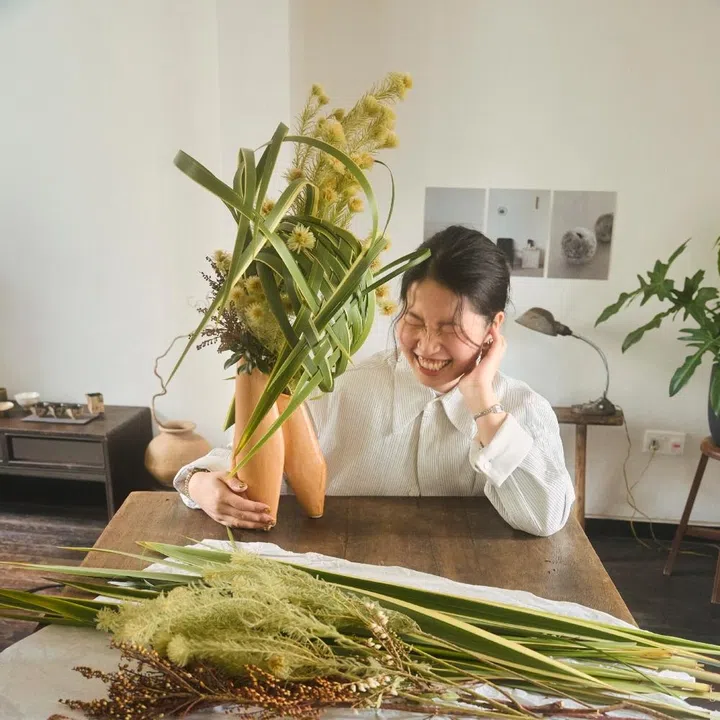
Ikebana artist Zoe Chen. Chen wears nappa leather shirt, Bottega Veneta. All other accessories, artist’s own. Location courtesy of Inner Teahouse
Interior designer by day, ikebana artist at other times, Zoe Chen creates botanical arrangements that sit somewhere between art and floristry. Working within the Sogetsu school, her compositions often feel playfully abstract yet serene, shaped by a designer’s instinct for balance, space, and movement. What began as curiosity after taking a class with an ikebana teacher friend has since grown into a practice rooted in observation and experimentation. Her work has appeared in group showcases and creative collaborations — including a food-meets-ikebana experience last November co-conceptualised by Singapore food artist Gong Hua — quietly making her a name to watch among a new wave of creatives exploring craft in fresh ways.
Zoe, how did you get into ikebana?
“I first got into the craft through artist Lilian Chow — we were classmates in a ceramics course, and I only later realised she is an ikebana teacher. When she started offering classes, I was curious to explore a new way of expressing myself. I’ve always loved plants and flowers, so I started with a playful, experimental mindset, just seeing where it would lead.”
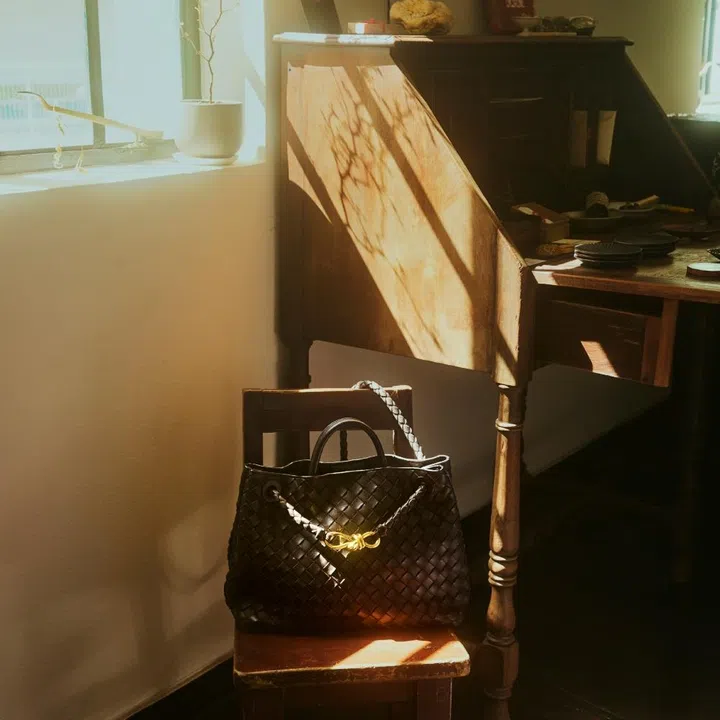
First launched in the Spring Summer 2023 collection, the Bottega Veneta Andiamo has quickly gone on to be a staple at the brand, instantly identifiable by the bag’s signature sliding braided straps that come with a metal knot. Its name, meaning “Let’s go,” in Italian nods to movement and versatility, making it a practical yet refined everyday bag that adapts to both hand‑carry and shoulder wear. Location courtesy of Inner Teahouse
Was there a specific detail about the Andiamo bag that stood out to you?
“What stood out to me was how the Andiamo interprets Bottega Veneta’s signature intrecciato technique in a fresh way. Compared to the brand’s other bags using the same weave, which tend to feel more structured, the Andiamo is softer and more relaxed. Its body drapes gently and moves with the wearer, giving it an effortless, contemporary quality. When I later learnt that Andiamo means ‘let’s go’ in Italian, it felt perfectly aligned with the spirit of the bag.”
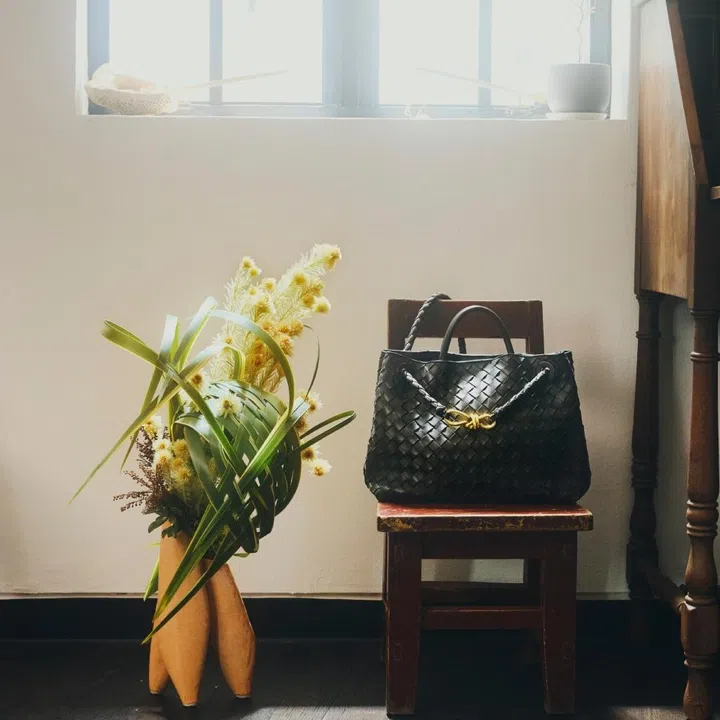
Chen wove together several plants to create a willowy lattice (on left) that echoes the sense of movement that the Bottega Veneta Andiamo bag has. Location courtesy of Inner Teahouse
Tell us about the piece you created for this project.
“The arrangement was inspired by Bottega Veneta’s intrecciato technique. I wove together natural materials like featherhead, New Zealand flax, and Japanese andromeda to form the main structure of the piece, exploring how the natural qualities of the materials can take on new forms through the act of weaving. The unique vase was also something I was immediately drawn to — its structure allows the plants to extend in different directions, which reflects the sense of freedom and movement that the Andiamo bag evokes for me.”
What about Bottega Veneta’s approach to craft resonated with you?
“For me, craftsmanship is not only about skill, but also about duration — the time devoted to understanding and listening to the material. In the brand’s Spring Summer 2026 collection, I was drawn to the close-up details of how different materials and weaving techniques are explored across both the garments and the bags. And when I was making my piece for this project, I observed the movement and character of the natural materials I was using. Learning how they naturally behave helped me weave the leaves and flowers into the form I wanted to express.”
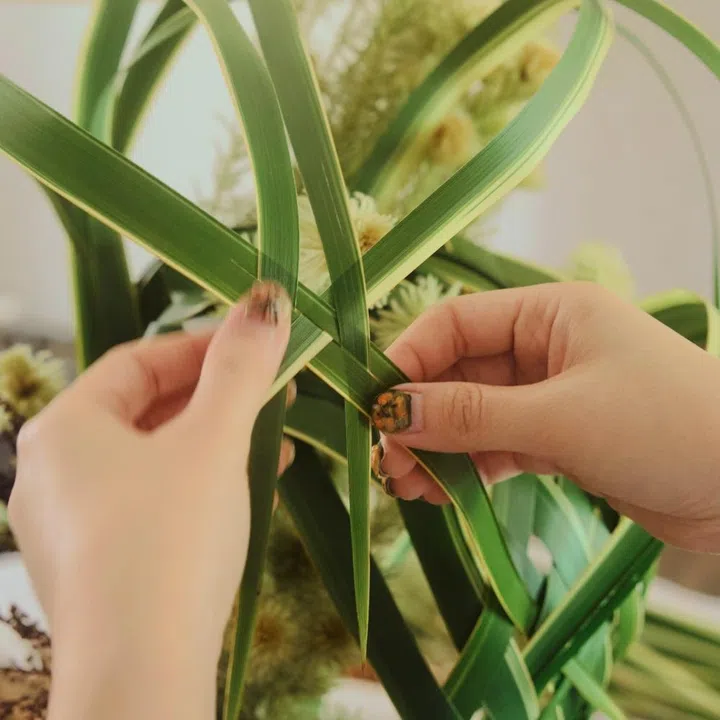
Weaving together a botanical interpretation of the intrecciato technique
And what do you hope people take away from your work?
“I hope people come away with a greater appreciation for craft and the creativity the brand brings. I also hope this work can inspire even a little curiosity about Sogetsu ikebana (a modern branch of the art that’s built on the idea that anyone can create flower arrangements anytime, anywhere, using any materials — with creativity and personal expression at its core). If it sparks a tiny bit of creativity or interest in others, that would be wonderful.”
In partnership with Bottega Veneta
PHOTOGRAPHY PHYLLICIA WANG ART DIRECTION JONATHAN CHIA
HAIR TAN ENG CHONG/KIZUKI+LIM MAKEUP SARAH TAN