
Elisha Danielle Makes Nostalgia Sound a Little Too Good
Singapore’s creative pulse isn’t waiting for permission. Across studios, stages and unexpected corners of the city, a new wave of young makers is building in real time, guided less by old formulas than by passion, instinct and a genuine curiosity to do things differently. Here, we meet emerging pop chanteuse Elisha Danielle, who’s fast making a name for herself as one of Singapore’s most alluring new singers.
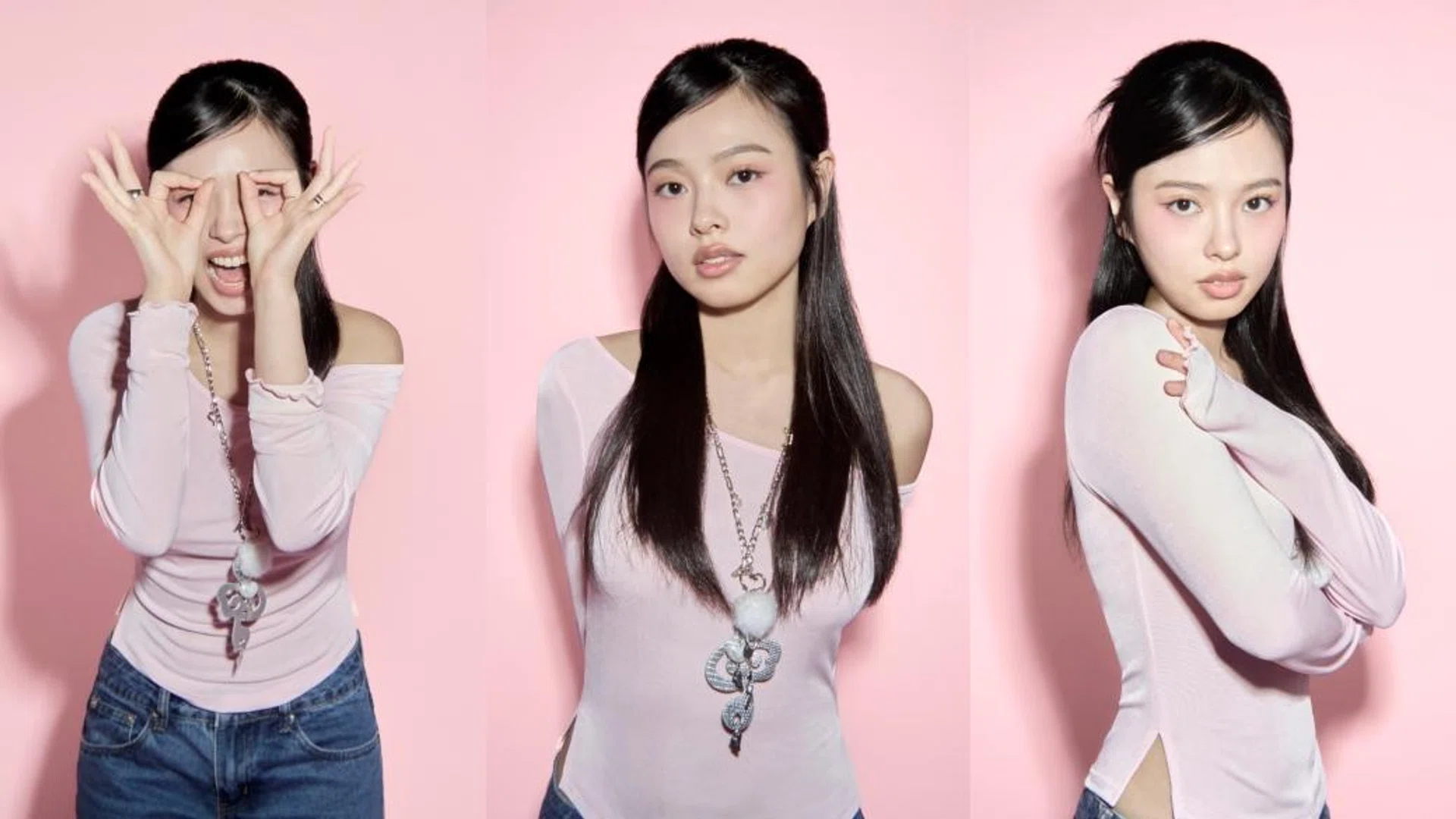
In an age where almost all content is engineered to be frothy and instantly catchy in the hopes of going viral, refusing to play that game might be the most refreshing refrain. Elisha Danielle does exactly that.
This vivacious singer‑songwriter debuted last October with the self‑penned, retro‑inflected earworm Pretty Easy, approaching the single like a hand‑crafted junk journal, even hand‑assembling the cover art with lace and Polaroids.

Very much part of a generation that wears authenticity like a calling card, she sees storytelling as paramount to her craft and weaves into her songs stories of her own as well as those of her friends – don’t expect no cookie‑cutter, designed‑for‑TikTok tunes from her.
“I think that our shortening attention spans have been affecting the way music is marketed to some extent, and this may start to affect the early stages of songwriting,” she says. “It seems more common now for people to write music with a certain structure just to make it more digestible on social media.”
Despite what she calls her “old‑school” approach, she still manages to connect: with just two singles, she has racked up more than 500,000 plays on Spotify and is signed to Sony Music Taiwan. How’s that for proof that slowing down, being intentional and sticking to one’s own creative flow can still make waves in a world obsessed with instant hits?
Elisha! For someone discovering your music for the first time, how would you describe your sound?
“While my current discography features two singles that are sonically different, my music as a whole (both unreleased and released) is reminiscent of nostalgic sounds with a modern twist and personal touch. Every time before I go into writing a song, I go in with the intention of telling a story. I would like to think there is a strong element of storytelling when people listen to my music.”
How did you first get into music?
“I grew up being surrounded by music. I started playing the piano at a really young age, and my family was involved in music as well. My mum used to teach guzheng and participated in a lot of choir activities; my grandparents and both my parents sang a lot at home too.
I first fell in love with pop music when I was around nine years old. I remember hearing Bleeding Love by Leona Lewis and Love Story by Taylor Swift and instantly falling in love with them. Since then, I had always wanted to learn how to songwrite, but I didn’t properly get around to it until I was nineteen. I think I’ve always considered myself a late bloomer in that sense.
I was lucky to start writing with some other very talented musicians and learned a lot from them. Even before being able to songwrite, I’ve always found ways to be involved and be creative in music, both in school and out of school.
I then took a songwriting unit during my last semester at university with one of my best friends, and that was when everything started to fall into place. It was when I wrote my first full-length song from scratch, fully on my own. Previously, I could write parts of songs but not a full-length one completely on my own. Even though, looking back, it really wasn’t the best, it definitely acted as a catalyst for my songwriting journey. And since then, I’ve been enjoying writing on my own and co-writing with others.”
Who or what are your biggest influences?
“My musical influences are constantly changing from time to time. I always have different phases. But overall, I have been very influenced by NIKI, Chappell Roan, ABBA, Gracie Abrams, Tristan, Juliet Ivy, and many more — a little bit of here and there.
In terms of topics and themes, I’m definitely inspired and influenced by the people around me. More than half of the songs I’ve written have been inspired by the stories of others and by places too. I like retelling perspectives through my songwriting. Sometimes, I reimagine a scenario and approach it differently by offering my own point of view, or how I would have acted or felt in that situation.”
How has social media changed the way you think about releasing music — for better or worse?
“I think social media has opened a lot of doors for everybody. With just a single click or a scroll, your music could end up on anyone’s recommended page anywhere in the world. I think it’s truly amazing. Over just a few years, the world has become more and more connected. At the same time, technology has advanced so much, especially now with algorithms.
I have personally found so many artists that I completely resonate with through social media, some of them even being my all-time favourite artists. If it were not for the current algorithm, I might not have had the chance to discover them...
However, the competition is definitely at its highest. Because of the endless choices that listeners have, I feel that most artists will come to a point where they have to ask themselves: ‘What sets me apart? Why should people choose to listen to me?’
I think that our shortening attention spans have been affecting the way music is marketed to some extent. This may start to affect even the early stages of writing songs. I feel like it’s common for people to feel the need to only write music within a certain structure that is more digestible on social media. I feel like I have been deeply affected by this too, and I sometimes start to limit my creative flow and doubt my initial ideas when they don’t fit into a certain mold of (TikTok-era music).”
What’s one thing about being a young artist in 2026 that people rarely talk about honestly?
“At least for pop music, I feel like young artists struggle a lot with the way music is measured more than ever before. Music today is often evaluated through numbers and metrics, and it’s easy to start feeling like your music is only worth whatever those numbers say it is. But I feel that whether a song is good or not should not be measured solely by numbers.
Another thing we don’t really talk about is how demoralising it can be when your efforts don’t translate into results. I think it gets harder to want to show up every day for your music. But I stand by the fact that you should stand up for your music and take pride in your work, effort, and vision — because if you don’t, who will? I sincerely think that young artists should be proud of what they create, regardless of external factors.”
What’s your current obsession that has nothing to do with music?
“Lately, I’ve been totally obsessed with collecting crystals, especially in jewellery form. I’ve been trying to create the perfect bracelet stack for a while now, looking for pieces that really speak to me, especially ones that hold sentimental value. At the same time, I’ve been revamping my whole room and can’t stop hunting for interesting little trinkets to decorate it with (that includes the crystals too).
I’ve also set a new resolution for myself: try not to box myself into just one particular ‘aesthetic’. and that goes for my bedroom as well. So right now, I’m on a little mission to find things that genuinely call out to me.
Another obsession I have is travelling when I am able to. I really like experiencing new things, places, and meeting all sorts of people. I have way too many places saved on my TikTok, Pinterest, and Instagram.
PHOTOGRAPHY LAWRENCE WONG ART DIRECTION JONATHAN CHIA
HAIR & MAKEUP SARAH TAN
An adapted version of this article first appeared in Volume 7 of F ZINE.