
In The Boonies Is Fostering A Creative Kampung
Craft tends to conjure up images of, say, artisans moulding ceramic vessels or whittling down wood. In Singapore today, though, a growing number of creatives are carving out pockets of space in which the essence of craft – as something that takes time, skills, passion and intentionality – extends beyond an analogue aesthetic. Here, we talk to the founders behind creative co-working space In The Boonies, who are hoping to create an inclusive space for artists to rally around and find camaraderie.
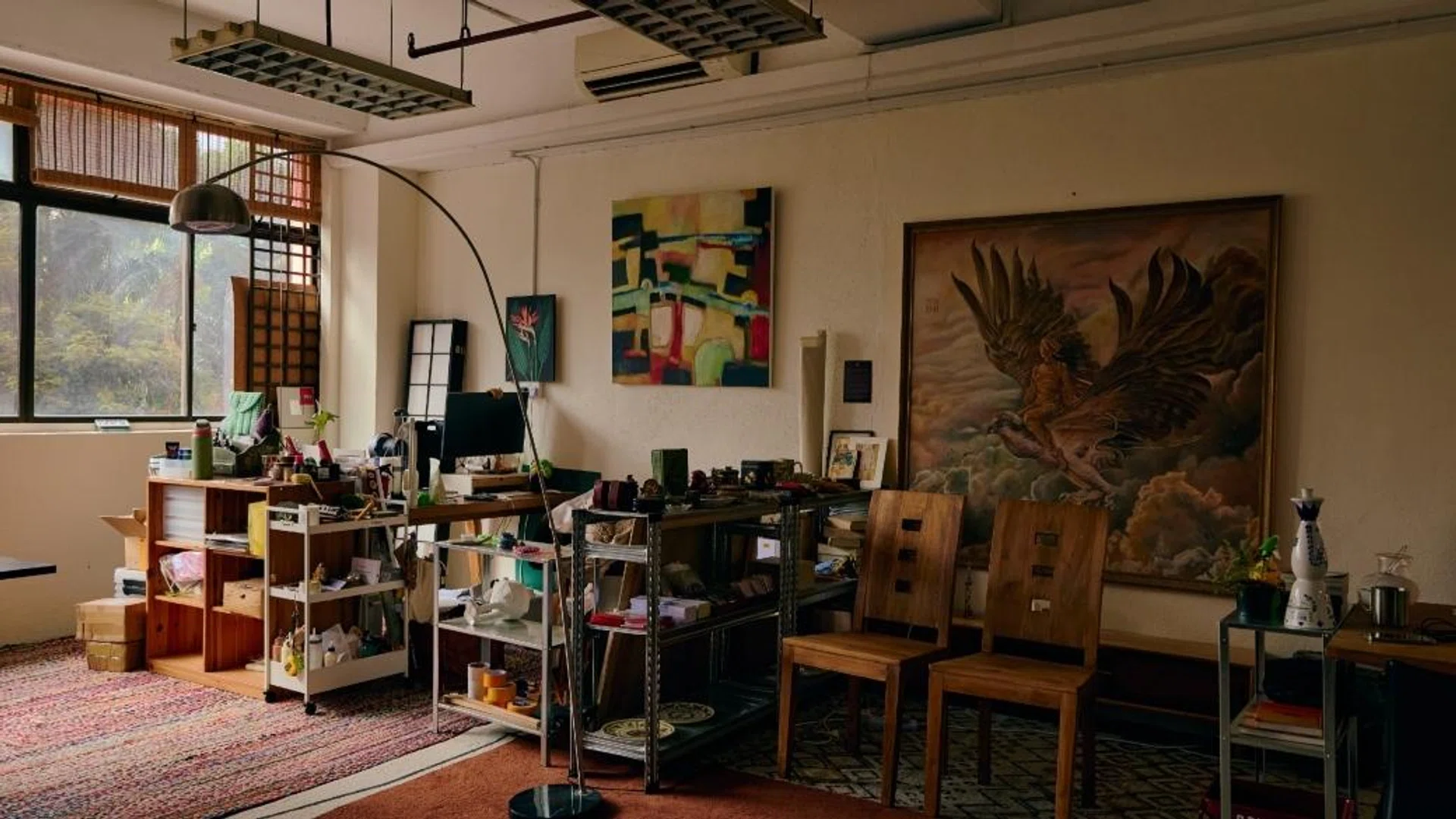
Think of the six‑month‑old In The Boonies in Geylang as less of a traditional co‑working space and more of a creative kampung designed for cross‑pollination. The brainchild of mural artist Amanda Ong and photographer and budding woodworker Deborah Chua, it’s meant to be a physical response to the isolation many independent makers face.
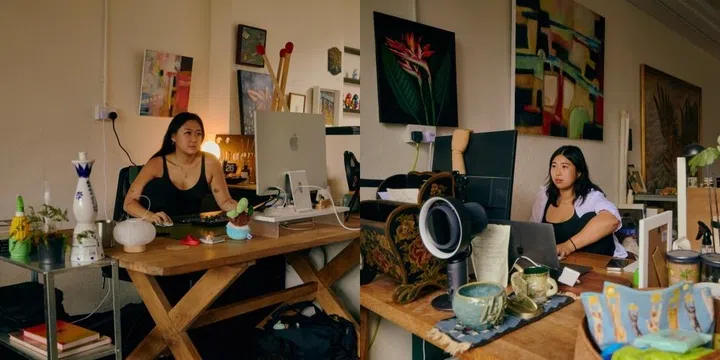
Co-founders of In The Boonies: Illustrator and mural artist Amanda Ong (right) and photographer/budding woodworker Deborah Chua (left) at their respective stations in the multi-use space
“For a lot of them, the hardest thing is access: to tools, peers, a space where their practices can be taken seriously,” says Ong. At In The Boonies, the hum of a tattoo machine blends with the steady rhythm of a woodworker’s chisel. By housing a rotating group of makers under one roof, Ong and Chua have created a sanctuary where craft is a shared way of life.
Here, they share more on the space:
Hi guys! How did In The Boonies (ITB) come to be?
Amanda Ong (AO): “It started with a simple, honest need. We both wanted somewhere to make things — not just a desk to sit at, but a real place to work with our hands, be around other people doing the same, and feel like we genuinely belonged. There was no grand plan at first. We found each other again after years of moving through different corners of the creative world, and In The Boonies grew out of that reunion. Once we started talking about what we both wanted, the idea took shape quickly. A space that was independent, built from the ground up, not waiting for institutional permission.
Most importantly: creating a community of friends where we can openly explore crafts, creativity, and different mediums, and generally have a non-judgemental space for everyone to explore their ideas.”
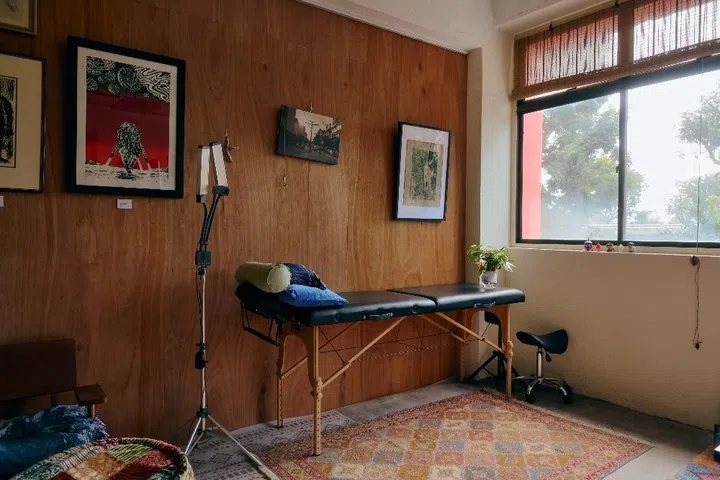
In The Boonies is home to a variety of creatives and their work stations. At press time, this is the intimate Tattoo Zone, presided over by artist Michelle Poon Mei Yi, who also helps to host the studio’s regular life drawing sessions.
How do your own creative practices shape how you imagine this space?
AO: “My practice has always moved between illustration, design, murals, and brand work. What ties it together is the belief that art can be accessible and functional in everyday life. In Singapore, it’s almost elitist? But art is all around us. Focusing my craft on public art and meeting those around my practice has shown me that art is abundant. And that’s not something we practise in Singapore. That thinking is baked into ITB. It is not a white-cube gallery. It is a place where you can work with papier-mache or reused materials alongside someone doing something completely different, and both feel equally valid.”
Deborah Chua (DC): “I grew up in the workshop watching my uncle repair and restore furniture meticulously; he took pride in his perfectionism. I guess that rubbed off on me. Photography trained me to notice the small things — grain, texture, light, the story in a material. Woodworking does the same thing, just with your hands instead of a lens. That sense of slowing down, of making something that lasts, is something I want the space to hold. We are not chasing speed or output. We are here for the process. Working with wood is definitely a step up from working with digital files. We are limited by how fast our hands work, how long a varnish takes to dry. Being a living material, wood is definitely much less forgiving than Lightroom (there’s no Ctrl+Z in real life), so it takes slower, steadier, and more controlled hands to work with.”
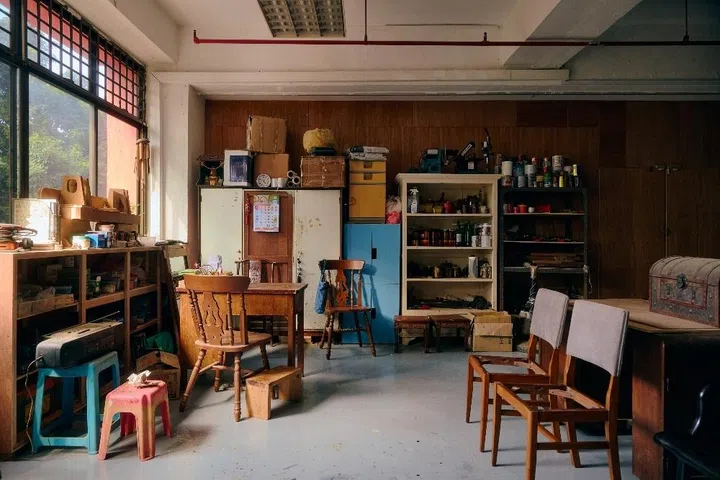
In The Boonies is home to a variety of creatives and their work stations. Here, Finders Keepers, also known as the “heart” of In The Boonies. Led by co‑founder Deborah Chua’s uncle, it is dedicated to woodworking and is the only space on site that is enclosed, due to the messy nature of the craft.
What can people expect to find at ITB?
DC: “We want the range to feel genuinely broad. Right now people can explore woodworking, illustration, papier-mache, working with reused and found materials, and mixed-media making. The through-line is always tactile, material-based work — things you do with your hands.
We are also building out programming that introduces people to mediums they may never have tried. The goal is to lower the threshold. You do not need to come in already knowing a craft. Curiosity is enough. Currently we are in the works of preparing workshops for the second half of the year where you can expect to learn tea appreciation, paper lamp-making, different forms of life-drawing, zine-making, calligraphy, clock-making and more.”
How do you see ITB contributing to Singapore’s craft and arts ecosystem?
DC: “Our goal is to be a creative hub, a starting point, a launch pad, or a space you can share to do whatever you want. We hope that our space is non-intimidating and non-judgemental. In a sense, that contributes to what Singapore’s creative ecosystem has been trying to emulate independently. We’re just an additional space trying to join the party, so maybe for the ones we’re nurturing, we pave a way for them so they don’t have to struggle as much as us, much like how the creatives before us had to.
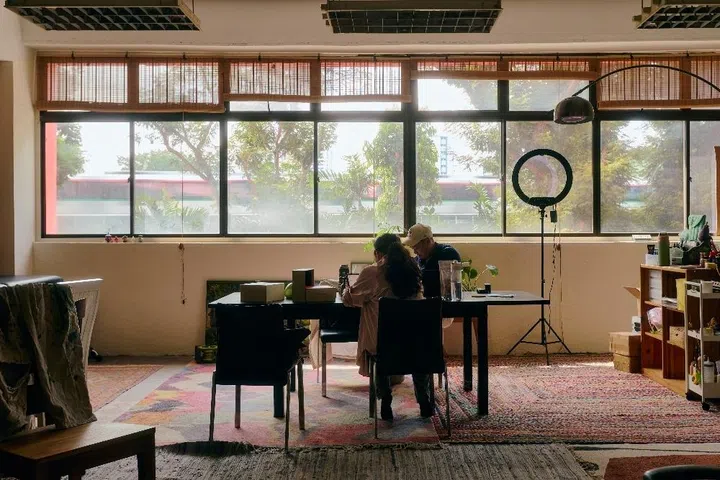
The space is also home to small biz entrepreneurs: pictured here is Layla Wei and Jeremy Vo, the founders of local pepper grinder brand Piper,
When a photographer/budding woodworker and an illustrator/budding mural artist share the same space, things happen that would not happen otherwise. Ideas cross-pollinate. Collaborations form. We continue to learn each other’s way of sharing our world and how we see things. People find new languages for their work.
We want ITB to be a node in a wider network — a place where independent voices connect, not just locally but eventually with makers and artists around the world through residencies and exchanges.”
What plans do you have for the rest of 2026?
DC: “We are focused on deepening what we have already started — building out the workshop programme and growing the community around the space. We are also exploring ways to plan for future ITB residencies and cultural exchanges that connect ITB with makers beyond Singapore.
The longer vision is an independent, self-sustaining creative ecosystem — rooted here but with reach. For now, we are taking it one season at a time, building by hand the way we always intended to.”
An adapted version of this article first appeared in Volume 8 of F ZINE.