
Tekad Kolektif: On Breaking Traditional Power Structures In The Art World
The young and egalitarian-minded art group Tekad Kolektif focuses on breaking traditional structures in the art world by prioritising the interests of artists first. Here, they share how they're doing so and the emerging artists they recommend.
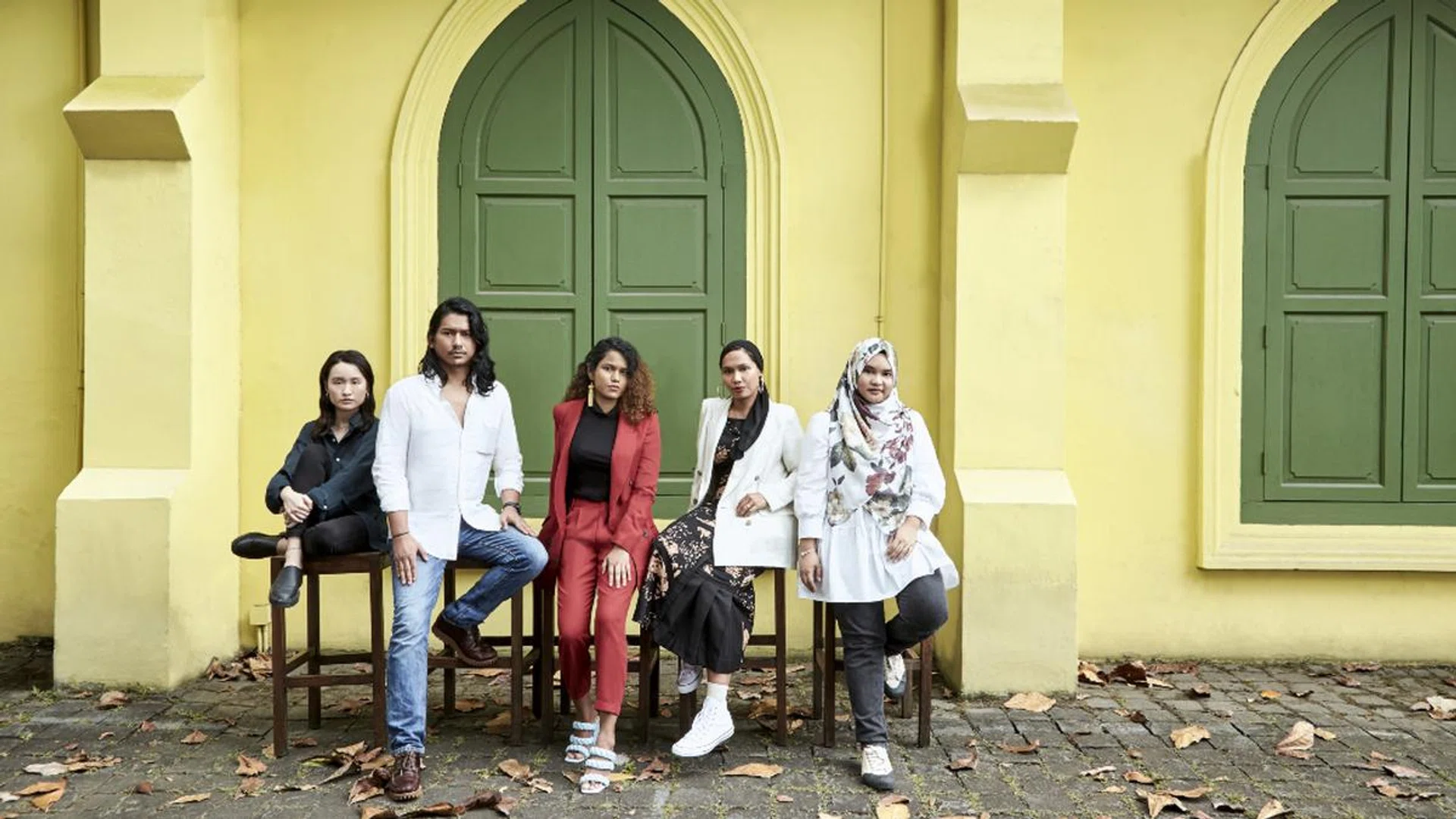
In Malay, the word tekad means determination – an apt name for this enterprising curatorial group. Comprising five members – (above, from left) Anna Chan, Masuri Mazlan, Elaine Thanya Marie Teo, Maisarah Kamal and Amirah Raudhah – the collective was founded in 2019 with the aim of “making the art world a lot more equitable”.
What that means: For one thing, it tries to upend long-held industry practices that tend to give artists the shorter end of the stick. Those who collaborate with Tekad, for example, are paid first; the quintet last. “Often, artists are so beholden to the system that they have to accept less than ideal remuneration conditions and are not paid on time,” explains Teo.
READ MORE: Moses Tan: On Facilitating Long-Term Support For The Arts
Commercial viability – a big consideration at traditional art institutions – also has far less sway over Tekad’s modus operandi. “We’re never opposed to experimental works that the market might shy away from. For example, perishable works have been a sticking point at most galleries, but not with us,” says Teo. Instead, the group aims to help crystallise an artist’s vision with as little interference as possible, offering an Eden to creatives.
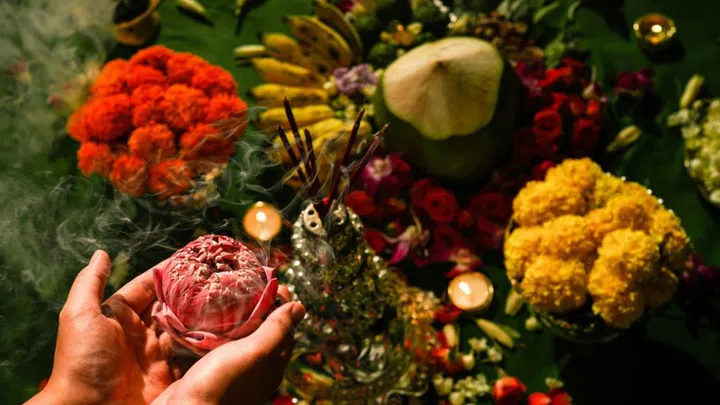
A photographic print (Transcendental Water Bodies – Offering, 2019, by artist Vimal Kumar), as part of Tekad Kolektif's most recent exhibition, With You Here Between: Defamiliarisations, staged last November at the art space Objectifs.
To date, Tekad has organised three group exhibitions, all focused on young, rising names – not unlike the collective itself, whose members are mostly artists in their 20s and early 30s.
READ MORE: Children Of The Soil: A Short Film Re-Interpreting Notions Of Malayness
“The younger generation connects with audiences on an intimate level through exploring issues such as identity and sexuality, and these are things pertinent in shaping the local landscape,” says Masuri. “We have the drive and freedom to decide how art intervenes in the modern environment as well as its place in the future. This requires us to be daring, to take chances on a regular basis and periodically defy institutional rules.”
Below, Tekad Kolektif members share with us their curation process and the emerging artists they recommend.
Maisarah: "We always work with artists that we fully believe in, each of them brings a level of focused care to their works that we believe are unparalleled.
Dipali Gupta (@dipalianurag) explores the female voice in power structure, Danial Shafiq (@pebblehugger) is an excellent artist creating compositions with found objects, Dylan Chan (@wip_dylan) is a young emerging artist specializing in photography that breaks the dimensional surface and Fatima Bano (@theinnercosmology) researches the spiritual and develops her own colours from pigments.
Foo Hui Wen (@huiwen.foo) is a young artist working with a focused eye on the lived environment, Fitri Ya’akob (@pimptri) creates beautiful elegiac photographic pieces. Ratna Sutara(@ladyratna.art) is a force with cyanotype photography. Fazleen Karlan (@fazleen.jpg) works with archeological practices to unearth overlooked narratives. Finally, Chang Xuan Hui (@chibitakocos_xh) is exploring an aesthetic that is breaking new ground."
(Artists mentioned have their works illustrated throughout this story)
Elaine: "Tekad Kolektif was set up in August 2019 by Amirah, Maisarah and Masuri. Anna and Elaine soon joined the collective. We started as a group centred on making the art world a lot more equitable in trying to conduct ourselves professionally as well as always open to input.
Our curatorial team kind of functions on a rotational basis on a year-by-year schedule. On a day-to-day basis, our group dynamics functions through a horizontal structure with each member bringing in their expertise. Tekad roughly translates to passion and determination, something we carry with us in trying to make changes in the art world.
As a collective looking to break traditional static hierarchical structures, we decided on a rotational basis for the curatorial role. Each year, a different member takes up the mantle of organising exhibitions and proposing projects. That individual becomes the main driver of the group during an exhibition.
All decisions should be made with the founding principles in mind. We try to create an open space where every member can express their opinions on any decision made on the curation side of things. That comes from a place recognizing that each of us brings very different and unique skillsets and expertise into every exhibition. There’s a strength that comes from being a collective, and that is the open sharing of ideas."
Elaine: "Tekad’s approach is bound by its founding principles. It has to function with a consensus and openness. We are never opposed to artists proposing experimental artworks or artworks that the art market might shy away from.
For example, perishable artworks have always been a sticking point with the commercial market. We’ve commissioned artworks that have these temporary elements and we always try to mobilize every resource we can to fully realize the artist’s vision. We see our exhibitions as an avenue to break open boundaries on artmaking and as such, there’s nothing really off-limits."
Amirah: "I believe as practising artists, we all have honest and raw experiences that we want to express through our works. I guess the need to achieve its meaning brings in a deeper sensitivity to the curatorial selection. The critical connection between expressing what’s ours and the audiences' experience while viewing our shows is what draws us into curatorial work.
Artists as curators roles fascinate me! I view the process as an extension of our practices. To have the freedom and control to create exhibiting opportunities as a young practising artist for other young practising artists. In the end, do we really need to draw the line between art making and exhibition making?"
Anna: "The curator is typically required to handle all sorts of administrative processes to bring an exhibition to its final form. While this seems like an unenviable task, it usually does provide access and a rarefied perspective on the major players in the art scene.
We believe that because the art world is opening up to traditionally side-lined narratives, the role of the curator has moved on to someone who needs to be both sensitive, with a sharp criticality and understanding of art historical power structures.
For us, there’s a greater emphasis on the programming of an exhibition and how it works with the artwork. We’re looking to sever the coldness of exhibitions and push the hilt on getting the wider public to see and connect with artworks."
Masuri: "The younger generation connects with their audiences on an intimate level with issues such as identity and sexuality. These are things pertinent in addressing and shaping the local landscape.
The strength of young curators resides in their autonomy when selecting fresh perspectives. In reworking these perspectives into producing critical and expansive exhibitions for the public, these bring a whole new level of artwork into play. In a sense, a curator is known to be the interpreter of art that connects between each individual’s artworks and the pressing curatorial premise.
Being an independent curator allows us to go outside of our comfort zone in order to satisfy our curiosities and intuitive judgments. We have the drive and freedom to discern how art intervenes in the modern environment and its place in the future. This requires us to be daring, to take chances on a regular basis, and to periodically defy institutional rules.
For example, Tekad Kolektif has showcased exhibitions in oft-kilter spaces away from the traditional white cube, such as a shophouse sourced by Maisarah Kamal for our showing at Singapore Art Week 2020."
Maisarah: "I think going to art school or immersing yourself in the arts certainly does help with bringing something to the table as a curator. It is a profession with a long and complicated history with a future trajectory open to all. With our shows, we are trying to break stiff power structures on who gets to decide narratives of being, so coming from different specialisations also helps with that. With all that is said and done, the desire to understand and work with artists is an important jumping-off point."
Maisarah: "The art scene in Singapore is in flux. There’s a greater openness to younger artists and curators. Institutions are willing to take a little risk and veer into commissioned works. We’ve also noticed a desire to cultivate residency spaces. I think providing collaborative spaces for artists to experiment with will bring about immense change in the art scene here.
Working in silos is beneficial to some extent but there’s an element of chance that develops when artists are able to have discussions and work at refining their techniques. The exchange also allows for institutions to understand the artistic process and breaks limitations. There’s a slight pressure to digitise but the challenge is to do it in a way that goes beyond the perfunctory."
Maisarah: "We are in the midst of deciding who takes up the mantle of (being the lead curator in Tekad Kolektif) in 2022. Amirah Raudhah is currently in a residency programme with NAC and SAFRA, with an exhibition to open to in SAW2022 (Singapore Art Week 2022), showcasing ecology-based collaborative artworks, titled Toa Payoh's Odyssey: Uniting through recycling.
Maisarah Kamal is working with APAD (Angkatan Pelukis Aneka Daya) to debut a piece their SAW2022 showing, Bridging Through the Age: An Intergenerational Collaborative Exhibition. Masuri Mazlan is working on a SAW2022 project, Somewhere in Bedok.
Elaine and Anna Chan, our go-to graphic designers, are both working with Objectifs on publishing the catalogue for Objectifs’ 2021 Curator Open Call Award. Elaine will also be organizing a performance art event, North- South Line with La Tristesse Opera for SAW2022 at Esplanade."
Photography Phyllicia Wang Art Direction Jonathan Chia Hair Linh/Itto+Lim Makeup Kenneth Chia, using Nars
A version of this article first appeared in the Jan/Feb 2022 Art & Music: The Analogue Edition of FEMALE