
The Graphic Designer Behind Anticipate Pictures’ Hyper-Stylish Artwork: Danielle Ng
Warning: contains ‘graphic’ content.
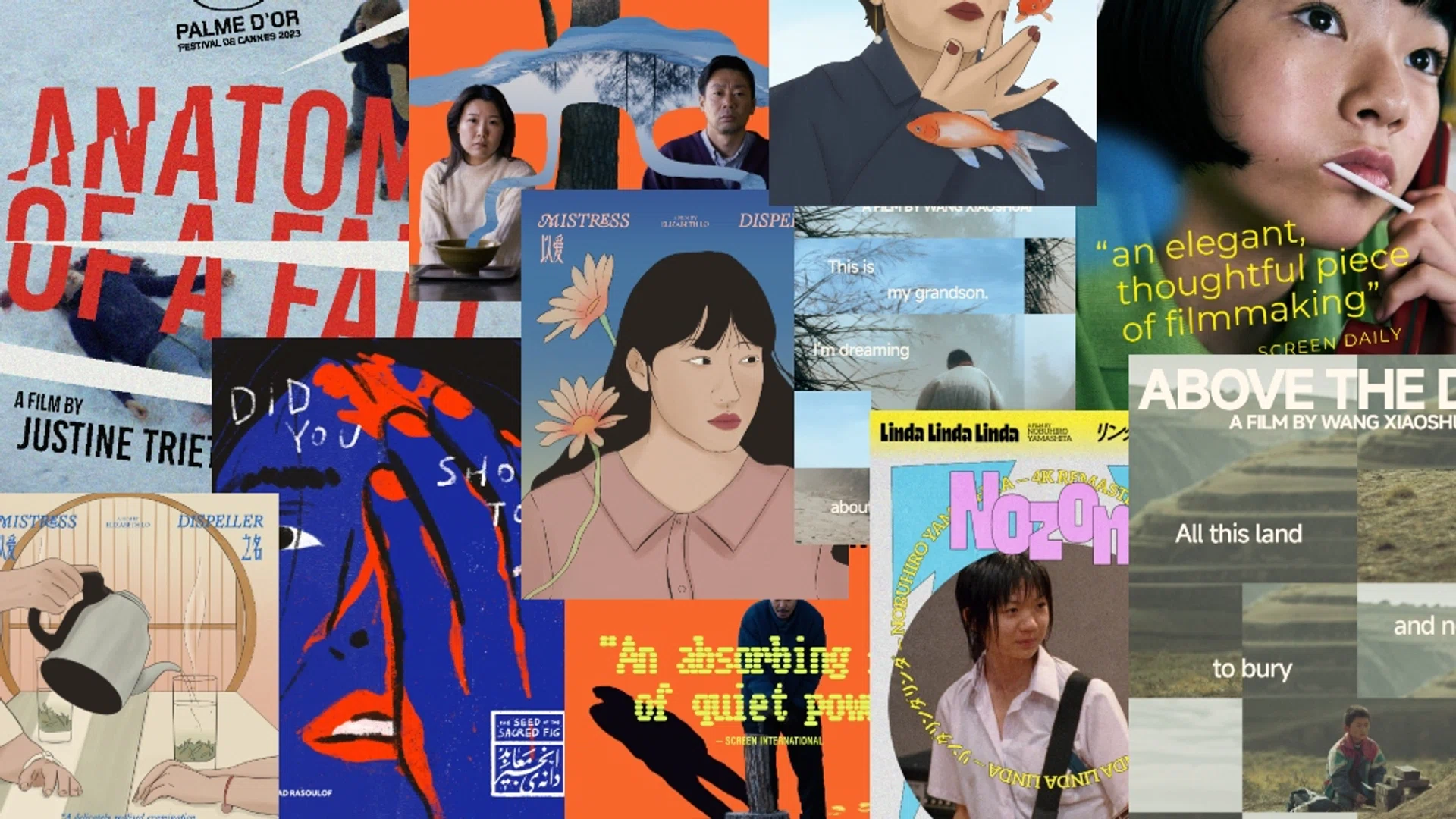
Besides bringing in some of the best movies from around the globe (nearly every one is “Certifieid Fresh” on Rotten Tomatoes), home-grown independent film distributor Anticipate Pictures is known for its hyper-stylish, often-cheeky scroll-stoppping artworks promoting said flicks – after all, the company was founded in 2016, when Instagram was starting to seriously blow up. Behind the majority of them is 30-year-old graphic designer Danielle Ng. Keng Yang Shuen catches up with her to find out about what it’s like drawing up the equivalent of movie posters in the age of social media and fading cinemas.
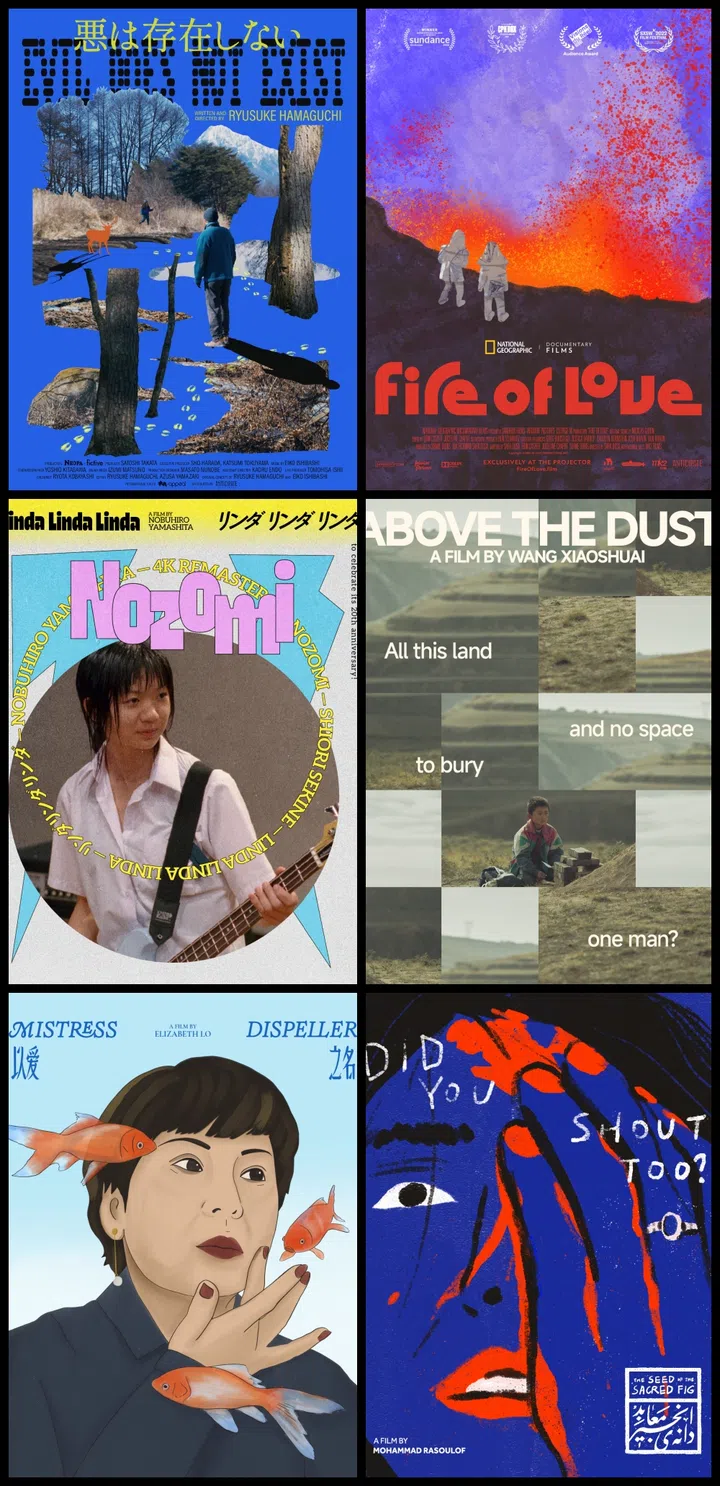
Just some of the many visuals Singapore graphic designer Danielle Ng has created for the independent films distributed by the home‑grown business Anticipate Pictures. In this age of social media, a good movie poster should help capture the attention – and intrigue – of audiences in order to compel them to watch it, she says. “I think the art of designing a good film poster or visual lies in saying a lot but also not too much.
DANIELLE! TELL US A BIT ABOUT YOURSELF AND HOW YOU CAME TO DESIGN VISUALS FOR THE FILMS ANTICIPATE PICTURES DISTRIBUTES HERE?
“Hi, I’m Dan, a full‑time associate creative director at the brand consultancy Somewhere Else. I also illustrate and design graphics for Anticipate Pictures part‑time. I first got to know Vincent Quek, the founder of Anticipate Pictures, when I worked on a project with him and (the non‑profit educational and cultural organisation) Alliance Francaise de Singapour. I was very moved by how passionate and sincere he was about films, and his mission of sharing them with more people really resonated with me. Back then, he was mostly screening at The Arts House, which meant it wasn’t easy for him to reach new audiences, and I felt that the films he brought in were extremely underrated and that his socials could do much more to highlight them.
I remember attending a screening of the animated Chinese dark crime comedy Have a Nice Day in 2018 and there were only three people in the room, including myself. At that moment, I felt a strong resolve to help out and do something for the community. For the first few years, I designed for Anticipate Pictures ad hoc and on a voluntary basis – a pro bono role, since the company was still finding its feet. It was only during Covid‑19 that I took on a more permanent part‑time role and now, I design for every film that comes through its doors.”
YOU WERE TRAINED IN GRAPHIC DESIGN. WHAT WAS THE BIGGEST LEARNING CURVE GOING INTO DESIGNING ARTWORK FOR OR RELATED TO MOVIES?
“I think a lot of the skills involved are the same as those in traditional graphic design because both are essentially about understanding your product and then communicating what it stands for – its story, its message and the emotions it’s supposed to evoke – in visual form. For me, the most interesting thing was that films are already inherently visual, so my goal in designing movie posters is to create visuals that fit naturally into or expand outward from the world that each film has already built. This is as opposed to coming up with something completely new that might not express the film authentically.”
HOW DOES YOUR CREATIVE PROCESS OF DESIGNING A PROMOTIONAL ARTWORK FOR A MOVIE START?
“I always start by watching the film and taking note of interesting elements or visuals within it that I could use or reinterpret. After that, I’ll process the whole movie and jot down themes or messaging that I find compelling. These come in really handy in building a visual picture of the general direction my imagery should take. Some are more straightforward. For example, Linda Linda Linda (screened here this August and September) is about an all‑girl high school rock band set in the 2000s, so I drew inspiration from that era and used bold type popular with rock bands of that period, for instance. For others such as Seed of the Sacred Fig (shown early this year), which is set in Tehran amidst nationwide political protests, the visuals are bold and emotionally resonant, inspired by protest posters.”
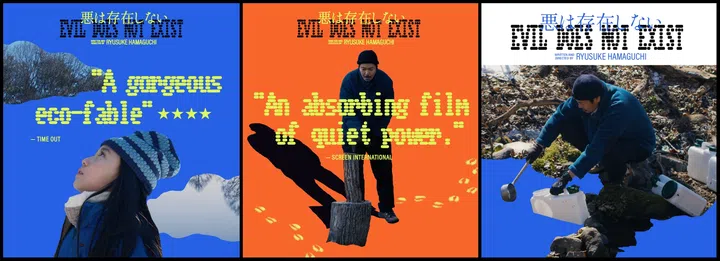
Creativity knows no bounds for Ng when she’s designing the visuals to promote the movies brought in by independent film distributor Anticipate Pictures. Every movie calls for a completely different treatment, as the artwork should “fit naturally into or expand outward from the world that each film has already built”, she says.
HOW DO YOU TRANSLATE AN ENTIRE FILM INTO A SINGLE STRIKING VISUAL, WHETHER IT’S A POSTER, A BANNER, OR A GRAPHIC FOR SOCIAL MEDIA? ANY PARTICULAR EXAMPLES?
“One of my favourite posters is the one I did for the 2023 film Evil Does Not Exist by Japanese auteur Ryusuke Hamaguchi (above). There’s a lot of symbolism in the film about water because the show revolves around a stream that runs through a village – tying fragments of its inhabitants’ lives together – and that is threatened, in turn tipping over this delicate ecosystem. Alongside this are themes of the unseen sides of human nature. To translate all of this visually into a single image, I cut out nature and human elements from the film stills, and composed a river using the negative spaces between them. In addition to recurring motifs that appear throughout the film, such as deer print, I incorporated harsh shadows to hint at what lies unseen.”
WHAT MAKES A GOOD FILM POSTER OR VISUAL FOR YOU?
“I think the art of designing a good film poster or visual lies in saying a lot but also not too much. We don’t want to reveal any spoilers and the visuals need to leave enough room for each viewer’s own interpretation. The best film posters I’ve seen either have really strong, impactful metaphors or distil the entire film into a single visual. To me, when you revisit one of these after watching the film, you’ll have an ‘aha’ moment and can appreciate a new layer of meaning that hadn’t been apparent before. This to me would explain why the common Hollywood poster today, which features only close‑ups of all the lead actors, is not as compelling as film posters of earlier eras, which tended to be more creative and graphic‑based.”
NAME ONE THAT COMES TO MIND RIGHT NOW.
“One of the most all‑time memorable film posters for me is that for the crime drama Fargo by Joel and Ethan Coen, which features a body splayed on the ground in stark contrast to a field of white snow. The entire poster is designed to resemble a cross‑stitch artwork and bears the tag line ‘A homespun murder story’. For a film that weaves fact and fiction together, this is a brilliant nod to the storytelling that the audience will encounter. The sense of it being a home‑made, folksy, cosy tale is also ironic and darkly humorous, given that it’s a murder tale. For someone who hasn’t seen the film, this poster is intriguing enough to pull you in. For someone who has, it’s an iconic scene with cleverly hidden details that nod to the nature of the story.”
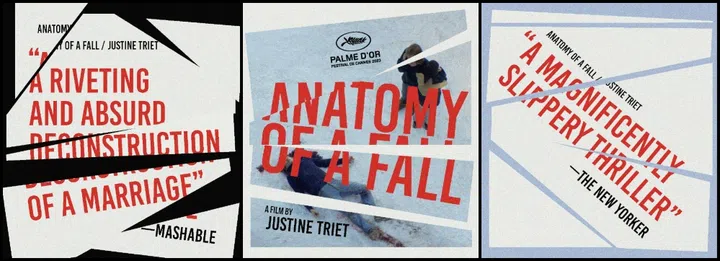
Another series created by Ng: the claustrophobic thriller Anatomy of a Fall.
HOW DO YOU SEE THE ROLE OF MOVIE ARTWORK TODAY, ESPECIALLY IN AN ERA WHERE AUDIENCES MOSTLY DISCOVER FILMS THROUGH STREAMING PLATFORMS AND SOCIAL MEDIA FEEDS?
“They’ve always been important, since most people like to look at nice things – ha ha! And this is even more so today, when we’re bombarded by so much content: Film posters need to be eye‑catching enough to cut through all this visual noise. That’s why it’s important to me that I represent the film accurately in my visuals, communicating a glimpse of what it’s about so audiences get curious or intrigued. That said, I don’t think design alone is enough to make a film successful. The majority of people still make their film‑viewing choices based on directors, awards, the cast and many other factors. What I can only hope to do is create a spark of interest that may lead to an unknown film getting a little more traction or attention.”
WHO ARE YOUR FILM DESIGN HEROES?
“Of course, one of the greats would be Saul Bass, who designed posters and title sequences for legendary films like Stanley Kubrick’s The Shining, and Alfred Hitchcock’s Vertigo and Anatomy of a Murder. I also really like Bill Gold’s posters for Alien and A Clockwork Orange, as well as Dawn Baillie’s poster for The Silence of the Lambs. Today, my other favourites are Vasilis Marmatakis, who designs the posters for Yorgos Lanthimos’s films – think Dogtooth, The Lobster and, most recently, The Favourite – and Aleksander Walijewski, whose posters include that for The Box, Pamfir and The Midnight Swim.”
WHAT IN YOUR OPINION IS ONE SINGAPORE FILM EVERYONE SHOULD WATCH?
“The whole reason I started designing for Anticipate Pictures was because I believed in helping stories that deserve to be told reach a wider audience, especially if they’re films that broaden perspectives or even make you uncomfortable. I Dream of Singapore by Lei Yuan Bin is a heartfelt and observational documentary that follows the stories of migrant workers in Singapore and the often invisible hardships they face, highlighting the human cost of unchecked capitalism. I watched it during the Covid‑19 pandemic as part of an effort to raise funds for TWC2 (the non‑profit organisation Transient Workers Count Too) and it was really hard‑hitting. I think everyone should watch it to truly see how unjust the cost of our progress is as a first‑world country, and to realise how many people suffer for it and that it shouldn’t be this way.”
THIS INTERVIEW HAS BEEN EDITED FOR BREVITY AND CLARITY.
This article first appeared in Volume 4 of F ZINE.