
Singaporean Author Divya Maniar On Reality TV, Social Media And Her Debut Novel, After Care
We’re all a little obsessed with watching other people’s lives unfold, aren’t we? In After Care, debut novelist Divya Maniar examines our appetite for attention and the blurred line between performing for an audience and simply living.

Let’s be honest, all of us are guilty of tuning into other people’s lives as they unfold online. From getting invested in which of Love Island’s couples are still together, to keeping up with an influencer’s latest controversy, there’s something undeniably compelling about being a distant spectator to someone else’s drama. And with social media giving us a front row seat to the lives of people we’ve never met, the line between entertainment and reality can often get a little blurry.
It’s this fascination with being watched, and watching others in return, that Singapore-born, London-based author Divya Maniar explores in her debut novel, After Care. The story follows Grace, a has-been reality TV star. Desperate to remain relevant, she clings to every opportunity to reclaim her former spotlight, even when it means capitalising on others’ misfortunes. She’s hardly the most likeable protagonist, but there’s something uncomfortably familiar about her need for attention, validation and connection.
First conceived five years ago, After Care began as an exploration of Maniar’s own relationship with the internet and obsession with reality television. What emerged is a novel that looks beyond the glitz of reality TV fame to examine the complicated relationship between visibility, agency and our desire to be seen. We speak to Maniar about creating a morally grey protagonist, our collective fascination with reality TV and what happens when the audience becomes just as much a part of the story as the people on screen.
Could you tell us a little about After Care and what first inspired you to write it?
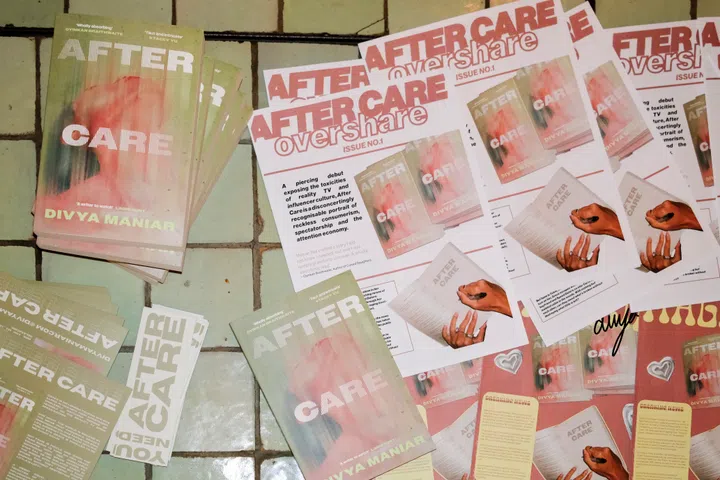
Divya Maniar (DM): “After Care is a novel about a reality star named Grace. Her fifteen minutes of fame have passed, but she subsequently grasps at every opportunity to remain relevant. I see the novel as my attempt at grappling with questions about visibility and agency in the digital age. Even in a world mediated by the mechanisms of social media and capitalism, I believe that we maintain our deep desire for connection. This book is my articulation of that belief.
It’s hard to pinpoint a precise moment which inspired me to write it, only that I’d been spending a lot of time thinking about my own relationship with the internet, my own obsession with reality shows. I remember feeling very trapped in my rituals of online interaction, and almost emptied by them. At the same time, paradoxically, I clung to my phone like a lifeline, as my primary means of communication. I wanted to interrogate this dizzying experience, to think deeply about the contemporary condition, and take seriously the interiority of things like influencer culture and reality television stardom. Grace, as a character, emerged from these contemplations, and then the novel built itself around her.”
After Care follows Grace, who’s acutely aware of her own flaws, yet continues to make choices that benefit her at others’ expense. What drew you to write about a character like hers?
DM: “It’s interesting that you point out Grace’s moments of self-awareness. She does seem to have an ability to distinguish between moral right and wrong, or at the very least to feel a semblance of remorse whenever she chooses to benefit from somebody else’s tragedy. I imagined that some readers might wonder why she keeps doing it anyways, or why it feels as if she cannot escape this compulsion.
I think it has something to do with what she identifies in herself as a ‘scarcity mindset.’ She’s convinced that everything is a resource, and further that every resource is limited. That she is making hard choices, but that they are necessary to her survival. I wanted to write about a character like her because I don’t think this mindset is uncommon. If so much of our lives is numericised and fed to algorithms, can we fault ourselves for beginning to make our own internal calculations, cold as they can sometimes be?”
There’s something deeply recognisable about Grace’s desire for attention and validation. What aspects of her character do you think readers might recognise in themselves, even if they disagree with the choices she makes?
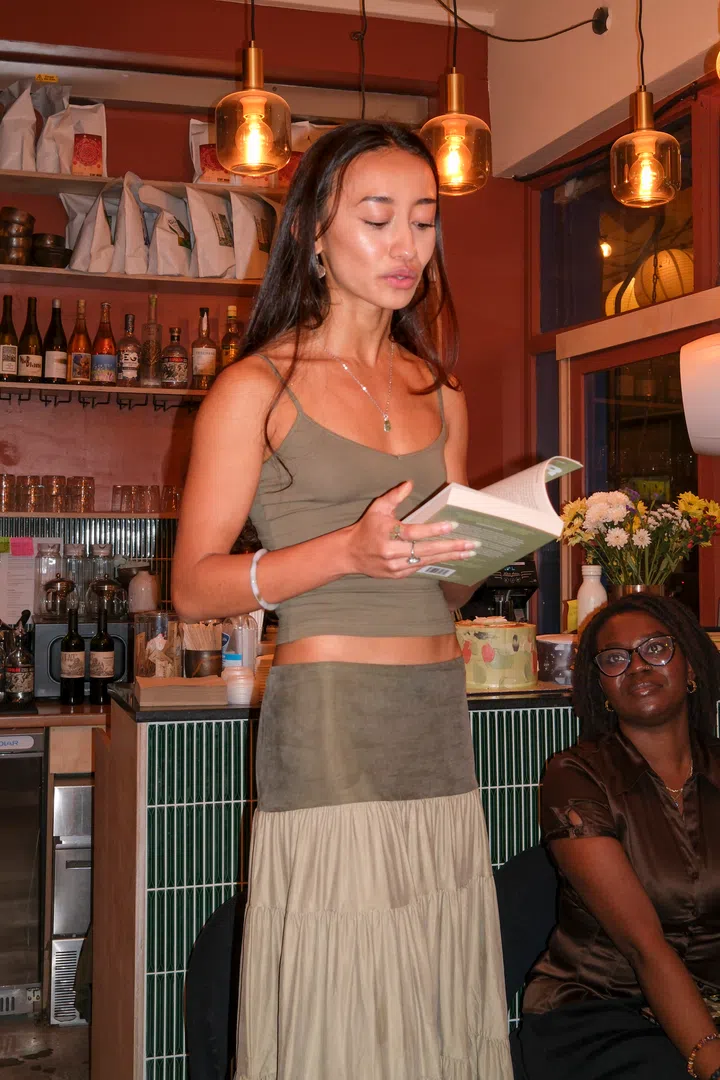
DM: “It’s exactly this — a vague, sometimes disquieting, and often uncomfortable, feeling of recognition — that I wanted readers to experience. The ways through which she pursues attention and validation can be decried as superficial, or even wrong, but the desires beneath it all are genuine: she wants tenderness and love; she wants to be cared for; she wants to be known and remembered, even if these things come at a profound cost. I guess I want readers to recognise in her these desires, and further to recognise in them something shared.”
Reality TV and the idea of surveillance is central to After Care. Why do you think we’re so fascinated by watching strangers’ relationships and personal lives unfold for our own entertainment?
DM: “Reality TV, in many ways, is a situation in which people volunteer to be surveilled. For the viewers, this is thrilling. Addictive. Reality television is so…watchable. You can have it turned on in the backdrop for hours on end. It has drama and intrigue but it doesn’t require you to suspend all disbelief. It’s fun in the way that the gossip from a friend of a friend often is. You feel that there are genuine stakes. None of these stakes affect you, yet you feel that your judgements of character do have moral weight because the people you’re judging really exist. Reality television appeals to our desire to impose our frameworks upon the world, while giving us a safe place to do so, distant enough from our realities while not being so far that our judgements do not matter.”
You first conceived After Care five years ago. How has the story evolved since that initial idea, and has your own perspective on its themes changed along the way?

DM: “When I first conceived of After Care, it was a different manuscript with a different name. My initial idea was vague. The novel, when I began writing it, was simply about a character who leaves home in pursuit of fame. The details came with time. The book built itself around the character, who in turn was built around a feeling. I suppose I started writing it with some idea of what I wanted to express, which was this deep malaise and unease. I knew I wanted to write about the nausea of hypermodernity, and the blurred lines between entertainment and life.
Plot details came to me along the way. For instance, I decided to use the reality television angle while I was alone in my room, just watching an episode of Love Island. I remember sitting up in bed like, ‘here it is!’ Aspects of the plot revealed themselves to me so as to solve the problem of translating my feelings into something that would make sense to somebody else.”
Were there any reality television shows that inspired After Care?
DM: “MTV’s Are You the One (a dating reality show where contestants live together and try to identify their pre-matched ‘perfect’ partners) is one of my favourite reality shows of all time — how it gamified self-perception in the pursuit of love is something I found really interesting as I was beginning to think up a format for the novel’s own show, Speed Daters. I was also watching a lot of Bravo TV’s Real Housewives and am always scandalised and inspired in equal measure by all the dialogues that take place on that show; I am convinced that this franchise has extended my understanding of what is possible in the English language.”
Who’s your favourite author, and what do you love most about their work?
DM: “This is an impossible question. One of my forever favourites is Virginia Woolf, whose prose taught me so much of what I know about the rhythms of writing. I have always admired how she could pick apart every mundane interaction, and reveal it for its cosmic scale, its complexity. In her essay, Modern Fiction, she writes: ‘Life is not a series of gig lamps symmetrically arranged; life is a luminous halo, a semi-transparent envelope surrounding us from the beginning of consciousness to the end.’ Her work is a bold attempt to capture the essence of that halo, and every time I re-read her novels, I feel that I get closer to seeing what she saw.”
As a debut novelist, what has been your favourite part of the journey from first imagining After Care to finally seeing it published?

DM: “One has obviously been seeing the book out in the world. It’s surreal. The first time a bookstore handed me a stack of books to sign, they apologised to me, as if I were experienced enough in being an author to start finding this task tiresome. I wanted to laugh, to tell the bookseller that there was no need to apologise for giving me a moment that had, until then, been the dream of my life.
But another part of the journey that I’d like to talk about came a while before publication, and it was when I was working with my agent, Monica Macswan, on earlier drafts of the manuscript. I felt — and still feel — so lucky to be working with somebody who so completely knows and understands my vision. This was my first book, and I feel that it was not in the process of writing my first draft, but in the process of editing it, that I grew the most not only as a writer but also as a person. Her support and relentless belief in me and my work helped me bring the book into the world, and my conversations with her have been a huge highlight of my writing life.”
Which books would you recommend for someone who enjoyed After Care?
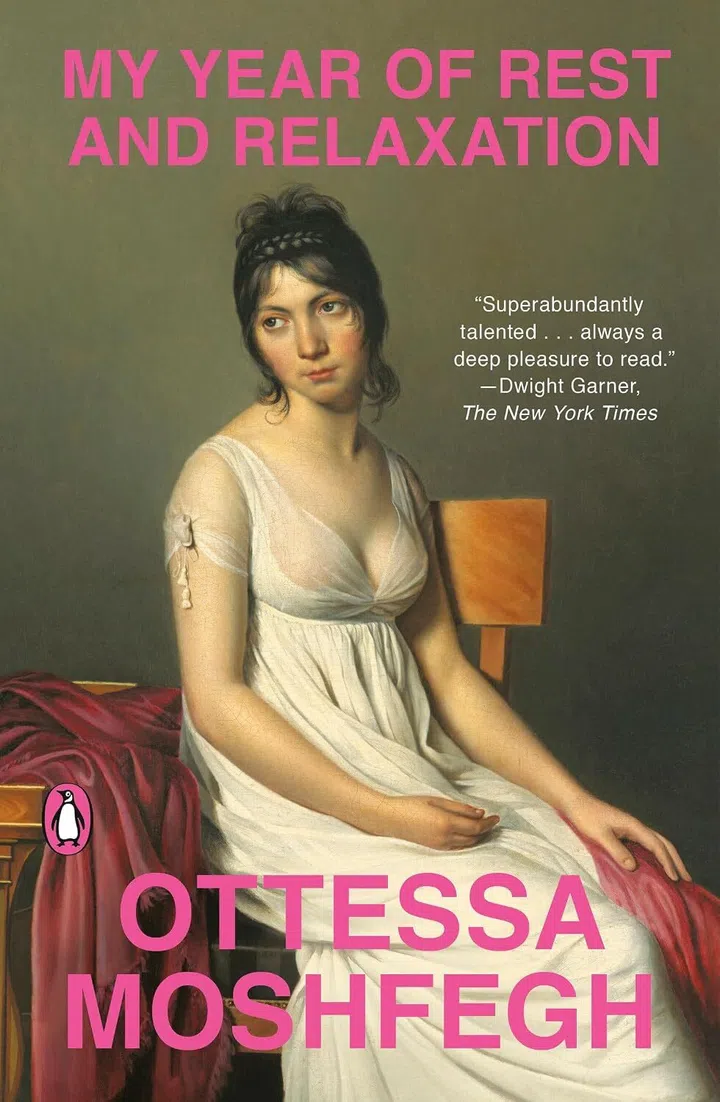
My Year of Rest and Relaxation by Ottessa Moshfegh, follows the protagonist who, as the title suggests, attempts to spend an entire year tucked away in a pill-fuelled hibernation of sorts, having grown disillusioned with the world around her.
DM: “Trick Mirror by Jia Tolentino. An Apprenticeship, or The Book of Pleasures by Clarice Lispector. The Guest by Emma Cline. My Year of Rest and Relaxation by Ottessa Moshfegh. To the Lighthouse by Virginia Woolf. Ripe by Sarah Rose Etter. Happiness & Love by Zoe Dubno.”