
Divya Maniar On Writing Her First Novel And Growing Up Alongside It
For F ZINE’s latest issue, we asked five Gen Z creatives to interpret its theme, Coming of Age, through a personal essay. First up, author Divya Maniar: if you’re a reality TV junkie, you’ll want to keep an eye out for Maniar’s upcoming novel After Care. The 27‑year‑old Singapore‑born, London‑based author’s debut work – out this October – follows Grace, a has‑been reality star pulled back into the spotlight after tragedy befalls her former on‑screen rival. Consider it a dark and tender dive into what it’s like to desire love and attention in a world of artifice. Here, Maniar writes about watching her own creation grow up alongside her – and what her book’s protagonist has ultimately taught her about herself.
“For a long time, I’ve used the language of maturity to discuss my writing projects. I say a draft is “young” when I consider it underdeveloped, as if it is a living thing. In a sense, it is; if you consider a story to be an extension of the person who wrote it, then it does carry a living quality. It shifts, it changes, and it responds to its writer’s emotional reality.
It’s been five years since the idea for my debut novel formed in my mind: It is about Grace, a burnt‑out reality television star as she navigates her life post‑show. Reading over parts of it, I am reminded of days I spent in my early adulthood – especially during the Covid‑19 pandemic – voraciously consuming media, which was back then an alternative to self‑reflection, a wilful escape from thought.
As my book enters the world, I cannot help but feel haunted by echoes of my former self, the version of me who sat down, all that time ago, with a baby of an idea, and with no sense of how profoundly it, and I, would age.
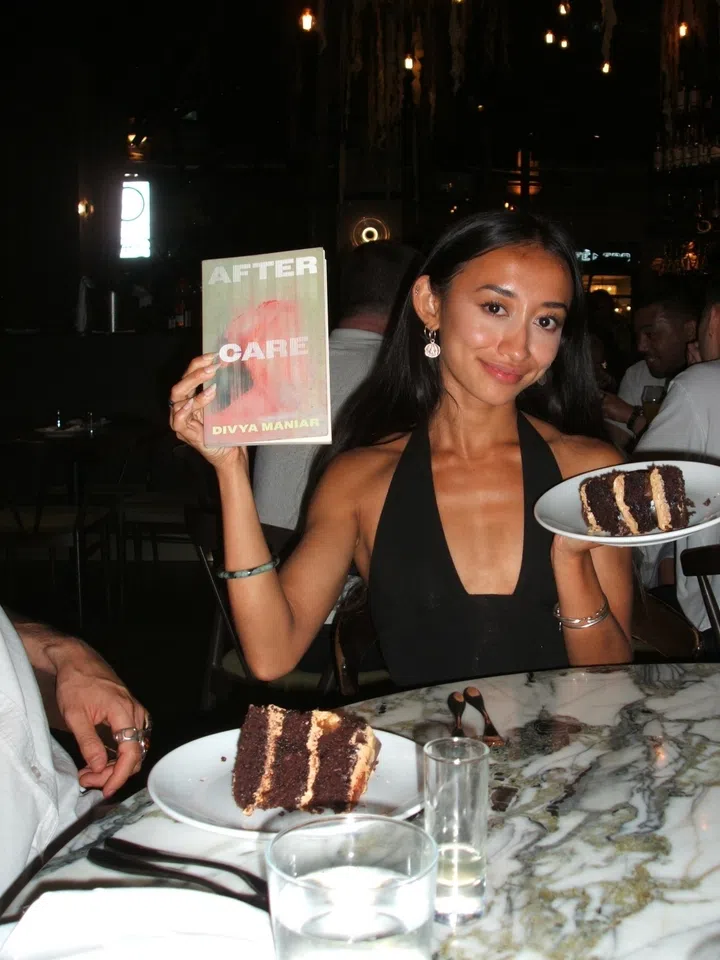
Singapore-born, London-based author Divya Maniar just turned 27. Writing her debut novel, After Care (pictured in hand), she says she learnt more about herself than she bargained for.
Publishing a novel was a longer process than I had anticipated, and I ended up reading, re‑reading and editing the book several times. With each iteration came an evolution of my thinking. What began as a fascination with the people I watched on reality shows, and a vague hunch that there was a thread that linked this curiosity to a larger philosophical pondering of media, performance and surveillance, led to a much clearer vision of the character I wanted to write about, and what her very existence has to say about contemporary living. The irony of this doesn’t escape me: that the shows which I’d used to numb myself have become, through this novel, my way into some of the deepest thinking I’ve ever done about the world we live in and my place in it.
My character, Grace, has few outwardly visible skills other than posting online and being pretty for the cameras. She’s an archetype that many have no trouble looking down on, who exists in an inaccessible social bubble that we’re often too quick to decry as “vapid”, or unworthy of further thought. Yet, I’ve come to see her world of Likes and Follows, gentrified‑new‑age‑tea‑brand sponsorships and false friends as a twisted mirror held up at a reality that I know intimately. The real work of writing began when I started to admit to myself that she had something to teach me, too, about my own relationship with social media, my set of digital‑era neuroses.
In many ways, she’s an extreme person. She’s a character, after all. She’s not me, but the fact that I’ve written her says something about me. By spending time with her, I was spending time with myself. Each time the novel met new eyes – first my agent’s, then editors’, and finally, early readers’ – I found myself feeling vulnerable. As if I’d exposed something I shouldn’t have. Writing a morally grey character felt like an implicit avowal of my least savoury thoughts.
In a way, it was.
Joan Didion put it best: ‘I write entirely to find out what I’m thinking, what I’m looking at, what I see and what it means. What I want and what I fear.’
Like Grace, I have found it difficult to tear my eyes away from my screen after I’ve posted a picture; like her, I have struggled to make decisions for myself, offsetting my own agency out of fatigue, or plain laziness; like her, I sometimes feared that if nobody was looking at me, I did not exist. The book revealed all this to me with shocking clarity as I was writing it.
Whether public or private, fact or fiction, to put something on paper, to journal, to record an emotion, is to crystallise a version of yourself in time. To write anything at all is to become an archivist of the self. To open yourself to the thought that, one day, you or somebody else might look at it. To publish a book is to accept that people will look and draw their own conclusions about you. As is their right.
Yet, there is something so disarming about the knowledge that the ink will dry on something so honest that it pulled fears out of myself that I didn’t realise were there.
Maybe that’s why I couldn’t stop editing the manuscript until the very end. Even in the final stages of proofreading, I highlighted swathes of text, begging my editor to consider new changes. I was addicted to making little amendments. I refused to accept that it was complete, or to accept that the book was no longer the “young” document I had sent to my agent those years ago. I was reluctant to surrender it to the archive, to crystallise myself so totally, to admit that it was done. It was hard to let go, and my desire to retain control over it manifested in small, pedantic ways. I started debates about commas and semicolons; I took endless issue with my own wording.
I suspect that I’ll struggle to consider any manuscript to ever be fully “mature” because no manuscript can be. A part of me will always read what I’ve written and be thrown back into who I was when I wrote it, someone much younger than the still‑evolving person standing at the finish line. But I realise now that an acceptance of this had, all along, been the point of the endeavour.
When I got the email from my editor to say that the novel had been sent to print, I felt a deep sense of relief. If the novel really were a living thing, I’m certain it would have been relieved too, that it was now able to stand on its own, without me. That, at last, it was all grown up.”
THIS ESSAY WAS SLIGHTLY EDITED FOR LENGTH, CLARITY AND STYLE. IT FIRST APPEARED IN F ZINE’S VOL 10 ISSUE.