
Singapore Electronic Artist Foxela Has Big Dreams For Asia’s Music Scene
Nigel Quah (best known as Foxela) shows how Gen Zs in Singapore can chase creativity beyond borders.

In a country often better known for its finance than its festivals, 23-year-old Nigel Quah, better known as Foxela, is rewriting the soundtrack of what it means to be young, Singaporean, and ambitious. The Gen Z music producer has built a catalogue of shimmering electronic tracks that travel far beyond the island’s borders, streamed by listeners around the world.
His story goes beyond beats and remixes, reflecting a generation of Singaporeans who aren’t confined by geography but are inspired to dream and create on a global stage. He tells us all about how he became an electronic music artist, what it’s like juggling school and his many side hustles, and his big dreams for Asia’s music scene.
Early sparks of music
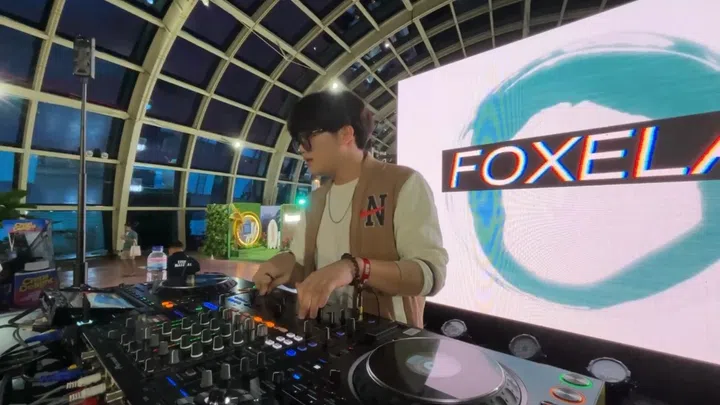
Foxela at &FRIENDS Festival, a music festival, in Manila, May 2025
Nigel has been surrounded by music for as long as he can remember. “I have always been exposed to music since I was really young,” he says. “My parents [had] loads of CDs that they would load during car rides, and my family [tuned] in to the radio every night. I’d call this my ‘first contact’ with music.” Artists like Don McLean and Phil Collins, he recalls, left an imprint that still lingers in his sound today.
Later, mobile games like Tap Tap Revenge widened his horizons, introducing him to electronic acts such as Owl City. But the pivotal moment came in primary school, when a friend introduced him to the Canadian label Monstercat. “The music that they had was very unorthodox to me back then. There were no vocals; not a single organic instrument could be found anywhere... but it sounded great!” he remembers. “That piqued my curiosity, and I went down the rabbit hole of music production from that day on.”
Becoming Foxela
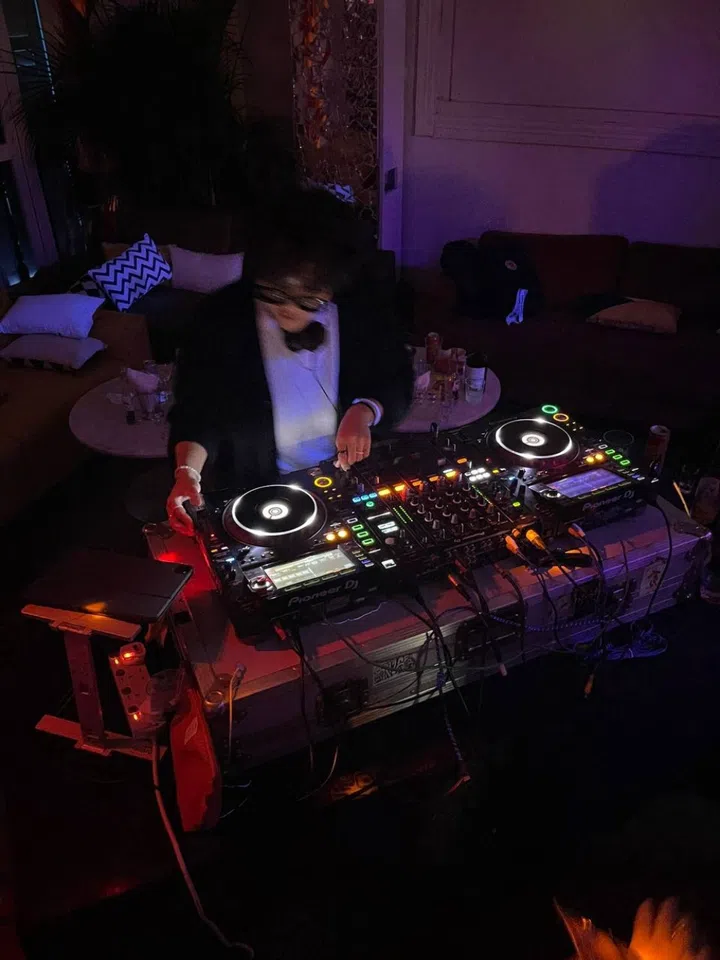
Foxela at Blu Jaz Cafe in September 2022
As a teenager, Nigel first went by “Cityscape,” a name plucked from a random generator. “I knew it was terrible, but I went with it anyway,” he laughs. “I knew I had to eventually replace the name, and I was constantly on the lookout.”
The name “Foxela” then came almost magically, inspired by a cancelled flight in New Zealand. “I can’t recall the exact conversation, but my mum said ‘Foxtrot’ for the letter F. And in that moment, I read the airport staff’s name, ‘Amela’. Somehow, my mind just connected the words and got ‘Foxela’! I thought it was really cool at that point and it just stuck,” he explains.
The Foxela Sound: From Dubstep to House and Jersey Club
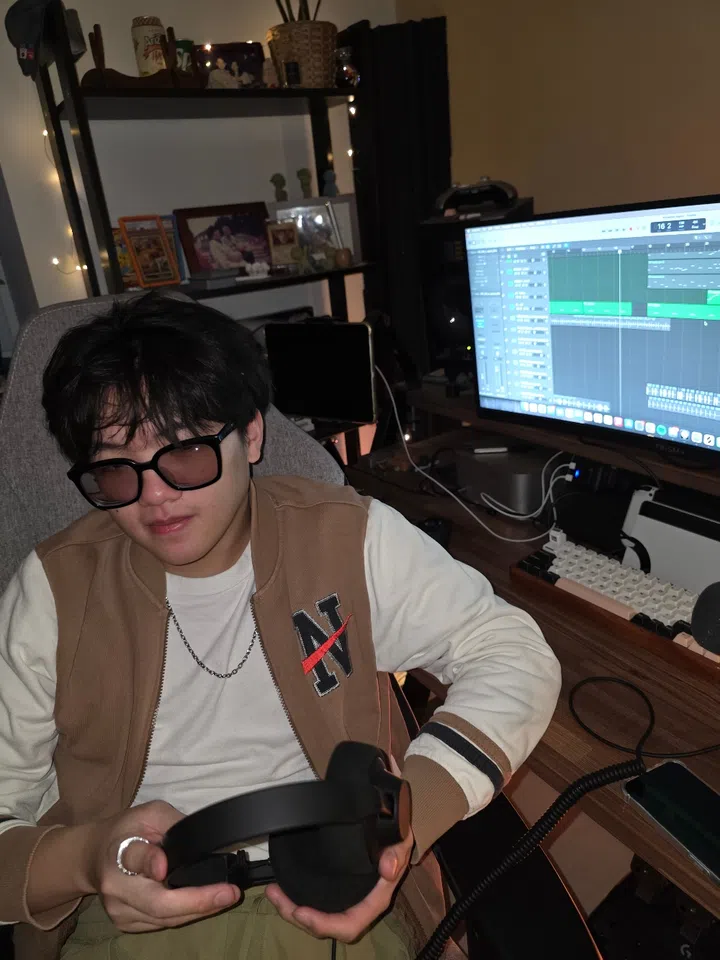
Foxela in his home studio.
Influenced early on by Skrillex, Avicii, and underground acts like Tristam and Pegboard Nerds, Foxela’s style evolved with time. “Initially, I was a massive fan of heavier genres like dubstep and trap, so naturally, I tried to mimic that with my music. But honestly, I didn’t do a great job!” he admits. Around 2015 to 2016, his tastes shifted, and so did his music. Today, the Foxela sound is rooted in the music genres house and Jersey club.
Inspired more by emotions and stories than by specific things or names, Foxela reveals, “I try to capture emotions like nostalgia, and translate them into sound.” His creative process starts later in the day when inspiration feels sharper, usually with something simple like a piano chord or a melody. “I believe a good song should still hold up in its most stripped-down form, so I always make sure it sounds good with just a piano first.”
From there, Foxela lets instinct guide the layers. “After this point, there’s no real fixed way to go about it. Sometimes I’ll proceed by adding in some percussion, or I’ll start finding some sounds to go with my melodies. It’s all about doing what feels right in the moment,” he says.
Gen Z Entrepreneurship: Balancing School, Startups, and Electronic Music
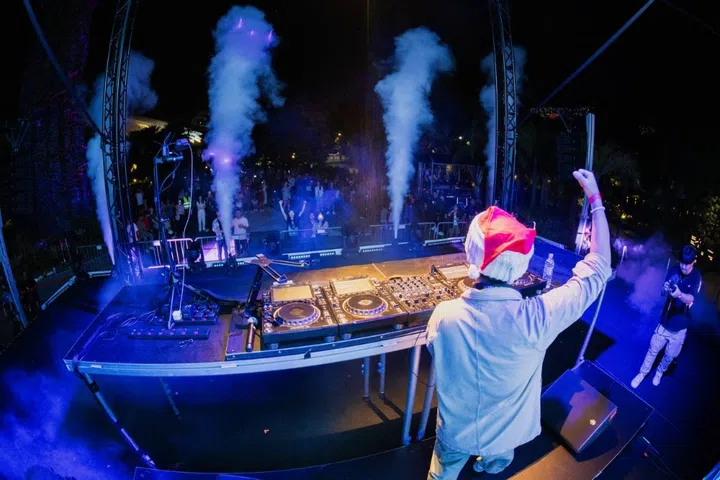
Foxela at Celebrate YOUth by Gardens by the Bay in December 2023.
Like many Gen Zs in Singapore, Foxela wears many hats. By day, he’s a business student; by night, an electronic producer and entrepreneur running not one but two startups. Acknowledging that assignments and deadlines demand the same energy as music projects, he adds, “Finding that balance isn’t easy, and it’s been putting my discipline and time management to the test!”
His first venture, onesolace, was founded in 2024. “[It] focuses mainly on the artist side of things – production, mixing, mastering, and creating sample packs,” he explains. The startup has already worked with major names like social music platform BandLab and game developer First Fun on the game Last War: Survival.
More recently, he launched O2 Audio with one of his best friends, Danny, known in music circles as DLKC. “We mainly focus on the corporate side of things. We’re helping brands with their sonic identities via several means, like sonic branding and jingles,” he says. Their work even featured in Guardian’s latest app campaign on TikTok and Instagram.
Running two companies might sound overwhelming, but Foxela sees it as natural. “[It is about having] a clear distinction between the offerings of each company, and of course, I run one with a friend, and one solo,” he says. “It can get challenging balancing two different sets of visions and ideas. But since the two startups are rather parallel to each other, there are a lot of similarities in the way things are done, thus making everything a lot simpler.”
Finding clients, he notes, is less about luck and more about consistency. “It’s mostly through building genuine connections with others and being consistent with the good work that you put out,” he says. “Word of mouth is a powerful tool! That’s not to say that it’s easy to land clients. There are always challenges.”
Balancing startups, school, and music means he takes a hybrid approach. “It’s pretty 50 50,” he admits. “I’ll just set certain objectives that I’ll have to complete by the week or within the day. If they get cleared, we’re good!”
The Singapore Electronic Music Scene and Branching Out to the Global Market
For Foxela, Singapore has been the springboard for his creativity. “Being in Singapore is great,” he says. “If you search for it, you can get exposed to a multitude of cultures, not just limited to those in Asia. Growing up, I’ve had friends from all around the world, and this has shaped the way that I think, and the way that I view things.”
The multicultural environment and robust startup ecosystem in Singapore, paired with a strong circle of supportive friends, gave him the courage to pursue a music career in a society often driven by academics. “There is a solid framework in place that encourages new businesses to be set up in Singapore, and I’ve taken advantage of this to marry my two loves, business and music, together. If I weren’t in Singapore, I don’t believe that it would be this easy for me to do such things,” he reflects.
Still, the path hasn’t been easy. Electronic music doesn’t have the same recognition in Singapore as other genres, and competition is fierce both locally and abroad. “This is why electronic music producers such as myself have to branch out to the global market,” he reveals.
Yet Foxela remains optimistic that the scene at home can flourish. “I do hope the scene gets more recognition locally, and I’m always toying with different ways to try and aid that,” he says.

The Internet has helped bridge the gap between his Singapore beginnings and a global audience. “As an artist, I’ve reaped the benefits of the Internet. Without it, I wouldn’t have even started,” he explains. Streaming platforms allowed his music to travel far beyond the island, and eventually led to a milestone he once only dreamed of.
That moment came when Monstercat, the very label that first introduced him to electronic music as a kid, signed his track Fallen. “It was really quite a full-circle moment,” he recalls.
Foxela’s Vision: Bringing Asia’s Electronic Music Scene to the World
Foxela’s vision is clear: to bring Asia’s electronic music scene to the global stage. “It’s always been my dream to be one of the first to show the world how vibrant and talented Asia’s electronic music scene is,” he says. He dreams of one day collaborating with heroes like Skrillex, Martin Garrix, and the late Avicii.
Beyond personal milestones, he hopes his story encourages others. “I hope to be at the forefront, creating music that resonates globally and inspires more Asians to pursue their own dreams in music. If I can show that it’s possible, maybe others will feel encouraged to take that leap too,” he shares.
For now, he’s working on new tracks, collaborating with fellow musicians, and growing his businesses. And through it all, his philosophy behind creating music remains simple: “The first rule for me is to always stay true to yourself… That’s how you find the ones who really connect with you.”