
The Duo Behind Museum Of Food Wants You To Talk About Singapore’s Heritage Cuisine
The Museum of Food is Singapore’s first dedicated hub for heritage food education. During a visit to their space in Joo Chiat Road, the pair behind it shared with us why learning about Singapore’s food heritage is so important.
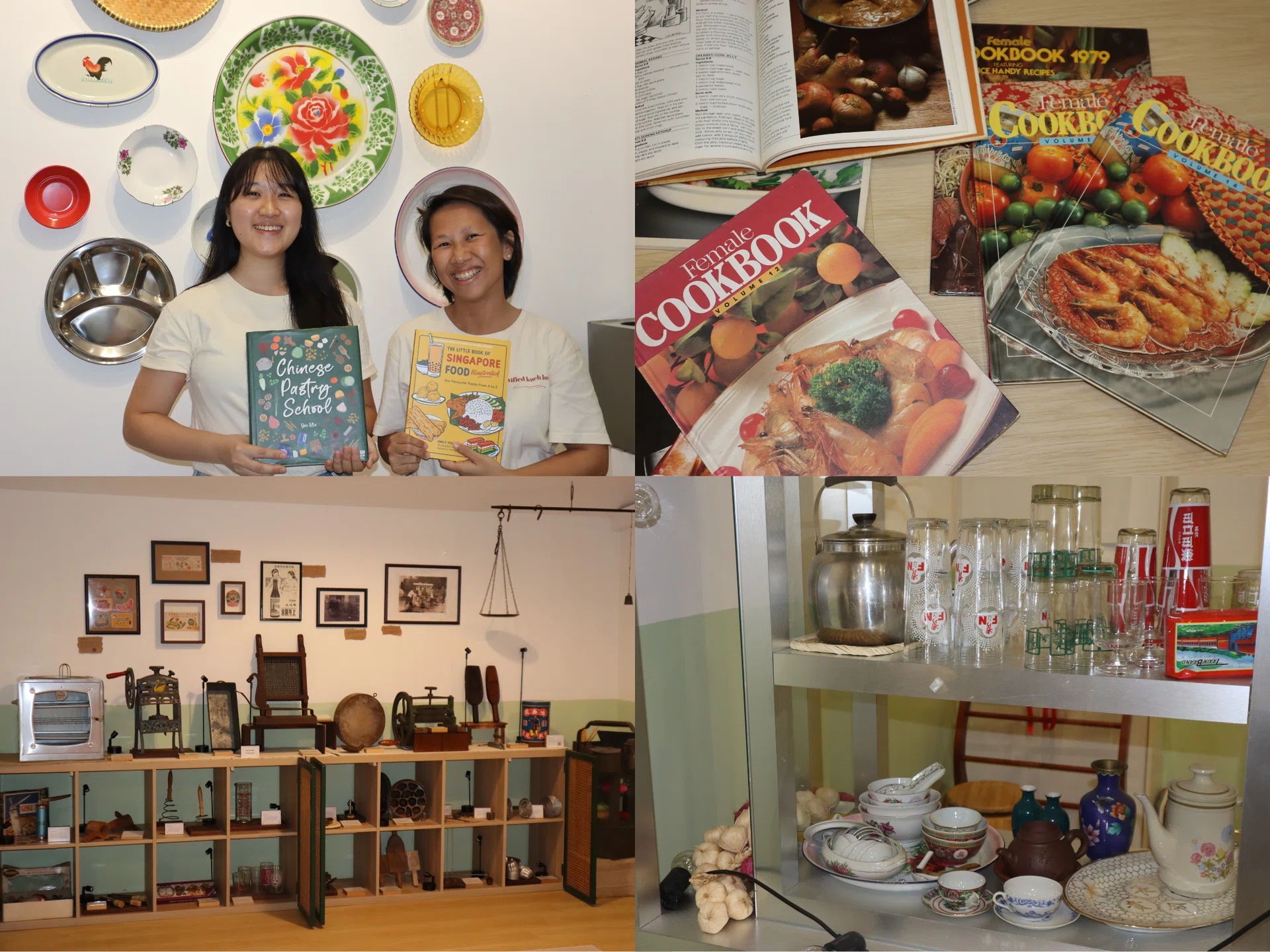
What comes to mind when you think of Singapore’s food scene? If you said matcha latte, bubble tea or mala hotpot – you’re not completely wrong, but you aren’t exactly right either. In a time where we obsess over food trends that have quietly seeped into our local cuisine, it’s also undeniable that traditional heritage foods have slowly been forgotten.
Enter Museum of Food, a dedicated space that’s ensuring future generations don’t forget (or misremember) the real local food of Singapore. Founded in 2024, the Museum of Food is a two-woman show run by co-founders Yeo Min and Emily Yeo – and when it comes to heritage food, you can probably trust these two cookbook authors to know their stuff.
Don’t be fooled by its name though, the Museum of Food is more than just a static gallery. Driven by a desire to preserve heritage food practices and leave a mark on Singapore’s food heritage, the pair created a multisensory experience where guests are encouraged to touch artefacts, share personal food stories and get all in on the action while they learn more about Singapore’s food culture.
Just last month, the duo unveiled their first brick-and-mortar space – a cosy two storey outlet tucked on the second floor of a Joo Chiat Road shophouse. Although barely a month old, the space has already played host to a slate of heritage food workshops and the Museum of Food’s first-ever public open house, which co-founder Yeo Min described as something “like a house party”. While we checked out their new space, the pair shared more about the museum’s journey, what to expect on a visit here and why preserving Singapore’s food heritage is important.
Hi Yeo Min and Emily! Tell us a bit about your background – what were both of you doing prior to this?
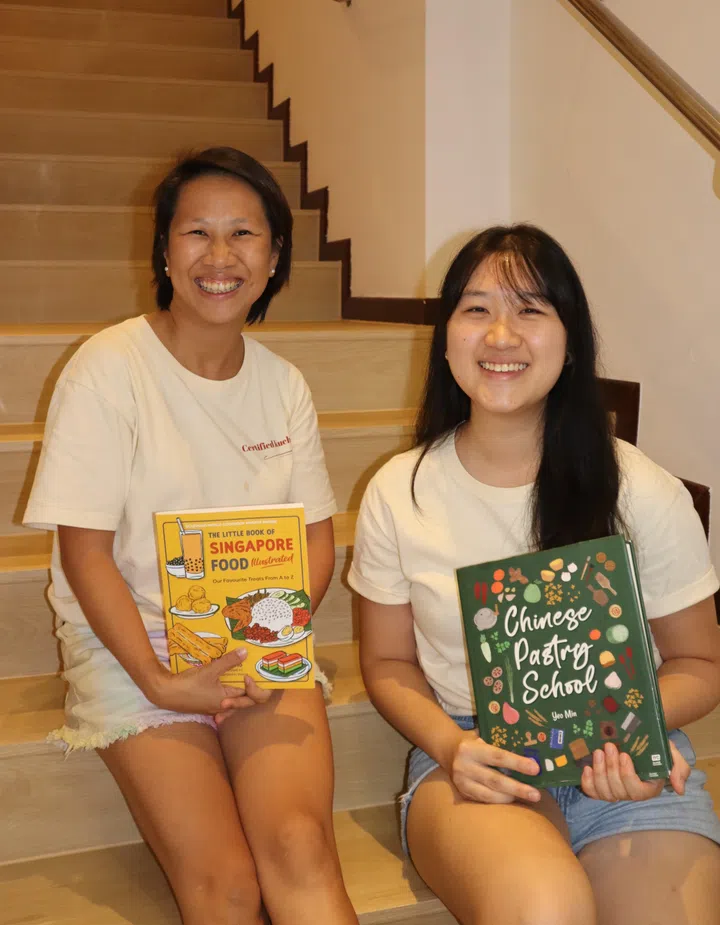
Museum of Food co-founders Emily Yeo (left) and Yeo Min (right), who are also the respective authors of heritage food books, The Little Book Of Singapore Food and Chinese Pastry School.
Emily: “I was an accountant by training, but I left and moved into early childhood education. Since then, I’ve been running a small cooking studio for children, focused mainly on teaching children basic kitchen skills. After I realised Yeo Min and I had the same cookbook publisher, I reached out to her via Instagram to connect. We met up for lunch, worked on a couple of projects together, and eventually decided to launch the Museum of Food.”
Yeo Min: “I was a social worker first and I worked for about two years before quitting and going to pastry school. At that point, I still wanted to focus on French pastry. I got into Chinese pastry sometime around my graduation period when I realised that many traditional Chinese pastry shops were closing down. After that, I wrote my cookbook – which was my most recent venture in the heritage space before launching the Museum of Food.”
Can you tell us more about the Museum of Food?
Yeo Min: “We want to be a hub for Singapore’s food – and by that, I don’t mean just hawker food which are dishes that already have names attached to them. We also want to talk about school canteens, home-cooked food, different food practices and rituals – things that you might not necessarily find represented elsewhere. So we’ve intentionally created a homely setting for these experiences to exist in.”
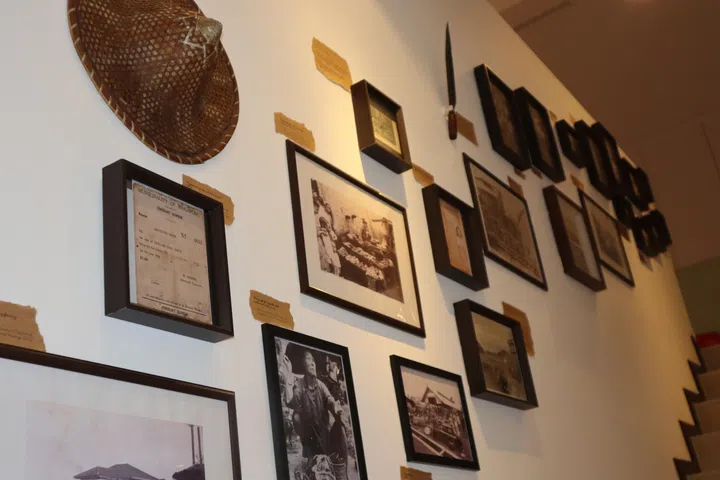
Pieces of history accompany your journey up the steps into the Museum of Food’s exhibition space
Emily: “We see the Museum of Food as a sensorial experience for everyone who steps through our doors. There’s a lot to look at and explore in the space – we have write-ups throughout the museum that are meant to accompany your journey here. As we bring visitors through the space, they’ll also encounter different artefacts – actual objects that were once used, loved, and are now preserved here with us.
We also pair the experience with something hands-on – be it learning how to wrap nasi lemak, bak zhang, making achar, ondeh-ondeh, takoyaki, or even a full food spread. The food possibilities are really endless, but the point is that there’s always a hands-on element. So when somebody comes in, they leave with a sense of gratification – something they’ve made, tasted, learnt, and can bring home with them.”
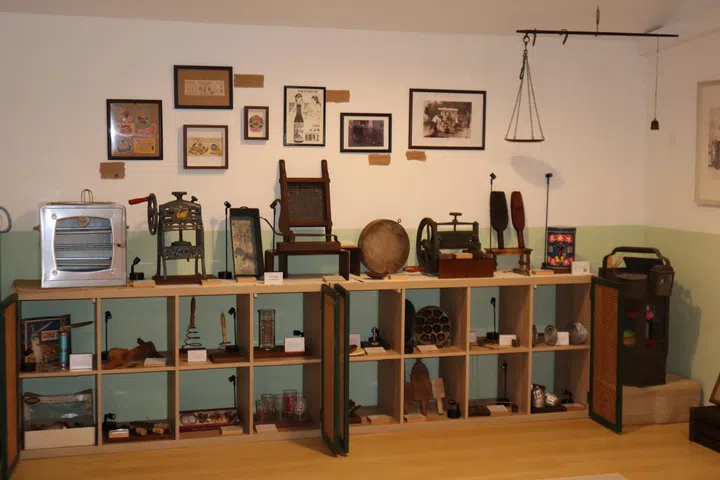
Museum of Food’s mezzanine floor features an exhibition space filled with vintage artefacts, heritage food tools and posters.
What inspired you to eventually open the Museum of Food?
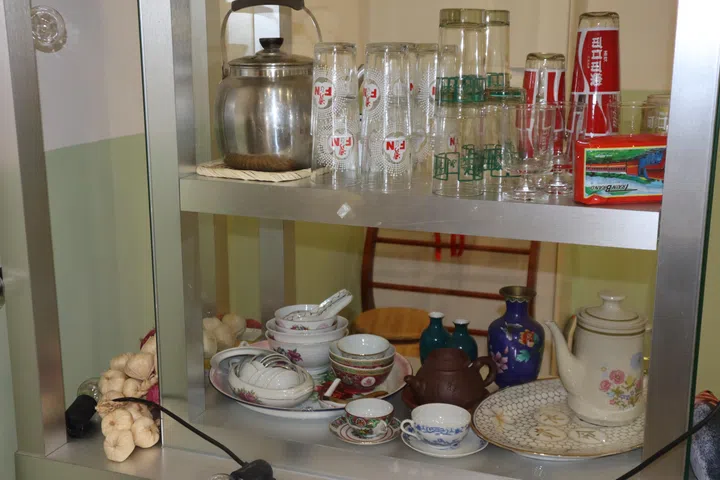
The Museum of Food houses a vintage food cart on the first floor which features some of Yeo Min’s mentor Chef Pang Nyuk Yoon’s personal items, such as drink glasses and oriental ceramic tableware, amongst other antiques she has donated to the museum for display.
Emily: “Through my experience teaching children over the years, I’ve realised that many of the children I interact with identify themselves as “English”, because of the language they speak and the influences around them. I think it reflects how unclear their sense of identity can be – who we are as a people. But I think that’s exactly why we want to do this. We want to step into this otherwise organic process of being swept away by global culture and stand there almost like a lighthouse and show that what we already have is incredibly rich and diverse as well. We see a lot of value in imparting that on to the next generation.”
Yeo Min: “Emily and I had this dream of opening a shophouse where people could come in for a dining experience, immerse themselves in local food culture, and really learn something. We wanted to make this educational and accessible to Singaporeans. Then we thought, “Okay, let’s open a museum.””
What are some programmes offered at The Museum of Food and what can guests expect when they visit?
Yeo Min: “Our space isn’t huge like the National Museum, and food isn’t really something you can just put on a shelf and look at. So what we do instead is organise monthly open houses. During these, ticket prices are intentionally kept affordable because we want them to be accessible. Those sessions are open to everyone – visitors simply buy tickets online when we release them. Each open house also has a different programme and theme.”
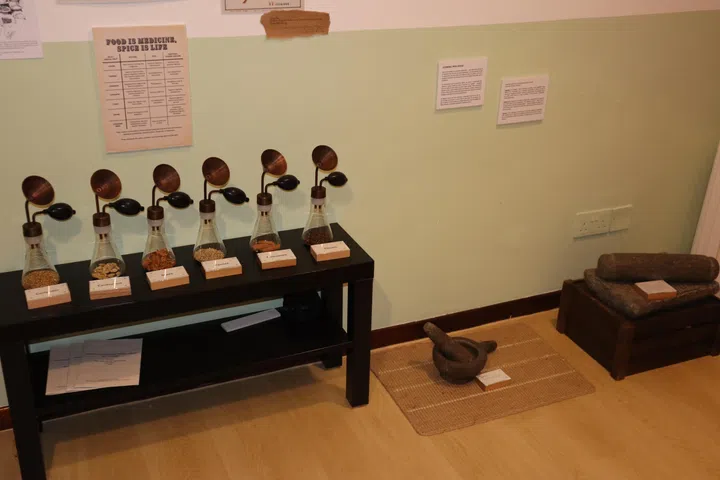
A spice corner in the exhibition space which features a range of spices that visitors can smell, a stone mortar and pestle known as batu lesung and a traditional granite grinder known as batu giling.
Emily: “On a day-to-day basis, we mainly operate through private and group bookings. We’ve hosted schools, corporate groups and tour groups. By the nature of the booking, visitors will always end up doing something with us before exploring the rest of the space. So for example, while they wait for their cake to bake, they will take a tour of our space and learn more about the artefacts here.”
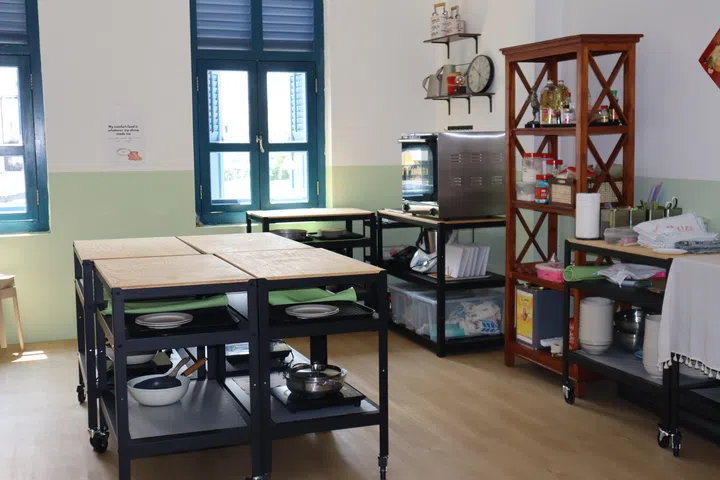
Within the first floor of the Museum of Food is the cooking space which the pair use to run food workshops, sometimes led by special guests.
Yeo Min: “For one of the open houses, we made sambal from a recipe found in our vintage cookbooks. So everyone who came got to taste something from 1939. It’s from experiences like this where you’ll get to hear personal stories from people of different cultures being shared. Everything feels very organic and lively because people are eating together, sharing memories, and reacting to the food.
Emily: “And especially with the seniors — a lot of them bring their parents and grandparents. You’ll see the older generation pointing at something and suddenly it unleashes a story that the younger generation accompanying them has never heard before. Honestly, if we had a surveillance camera that could somehow capture every story shared in this space, it would be amazing.”
How do you source for the antique tools and artefacts found in the Museum of Food?
Yeo Min: “It’s a mix – sometimes we find things online, sometimes in person. We have friends who help us source things – enablers, if you may. We also find things on Carousell. One of our friends runs bymyoldschool – a vintage shop on Instagram – so whenever she comes across anything food-related, she’ll let us know. One of our friends Christopher Tan – who’s a very established cookbook author – is always messaging me whenever he spots a good deal or a rare item, especially because he knows the value of all these vintage items.
For example, there’s this vintage cookie cutter set that’s on display in the museum now, which includes a heart-shaped pineapple tart mould made from brass that’s apparently very difficult to find now. I think it was only around ten dollars, so he urged me to purchase it because it’s quite unlikely for us to come across such a good deal again.
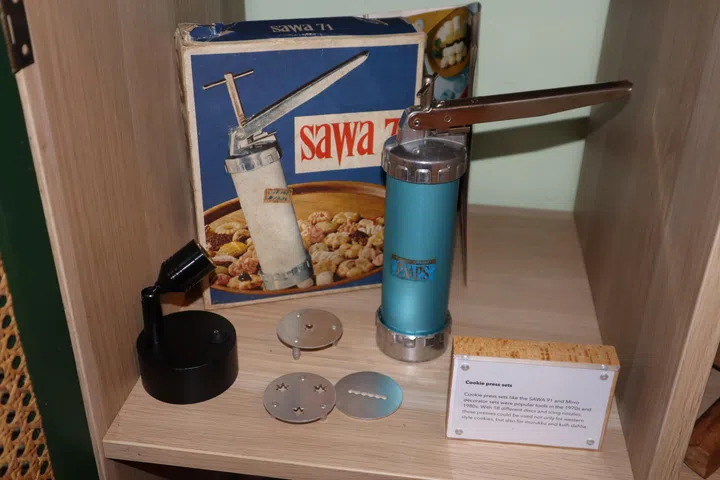
One of two vintage cookie cutter sets in the Museum of Food’s exhibition space is the Sawa 71 Cookie Press, which can be used to make not only Western-style cookies, but also traditional ones.
Emily: “Some of the items in our collection aren’t always that cheap, and sometimes people are shocked that we spend money on old objects. But during one of our recent open houses, I overheard Christopher saying to someone about how you can’t put a price tag on artefacts like that – simply because they’re priceless and it’s the cost of owning a piece of history. It’s something that really stuck with me.”
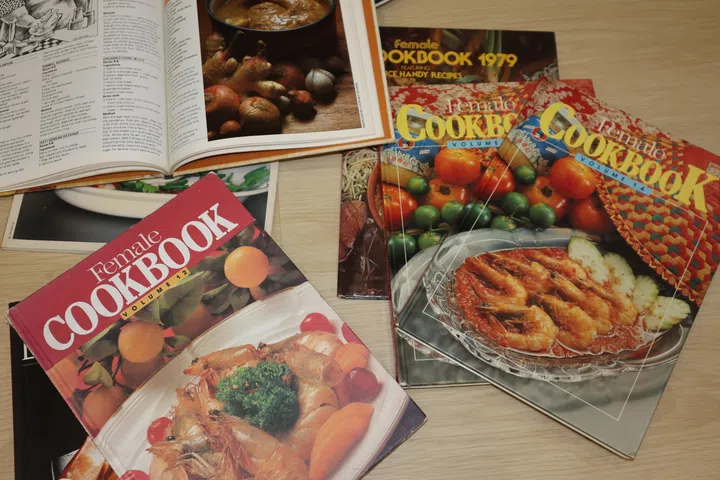
Before we rebranded as F ZINE in 2025, this publication was formerly known as FEMALE Magazine. Pop by the Museum of Food to check out these vintage FEMALE cookbooks from the ‘70s and ‘80s that the pair have collected over the years.
Which item in the Museum’s collection has the most personal significance to you and why?
Yeo Min: “One of the books I have was sourced from an old second-hand bookshops in Bras Basah, which costs around $250. When I saw it, I immediately recognised the author, Tham Yui Kai. He was one of the “Four Heavenly Kings” of Cantonese cuisine in Singapore and taught many cooking classes back in the day.
To me, this particular copy is very precious because of all the annotations inside. Since Tham Yui Kai taught so many cooking classes, my guess is that the owner of this book attended some of them or watched his recipe videos. It also has a cut-out from an old magazine, maybe a FEMALE magazine since he has some recipes in the FEMALE cookbooks. This book is very unique, because there’s only one copy with these handwritten notes inside – it carries someone’s personal history with it.”
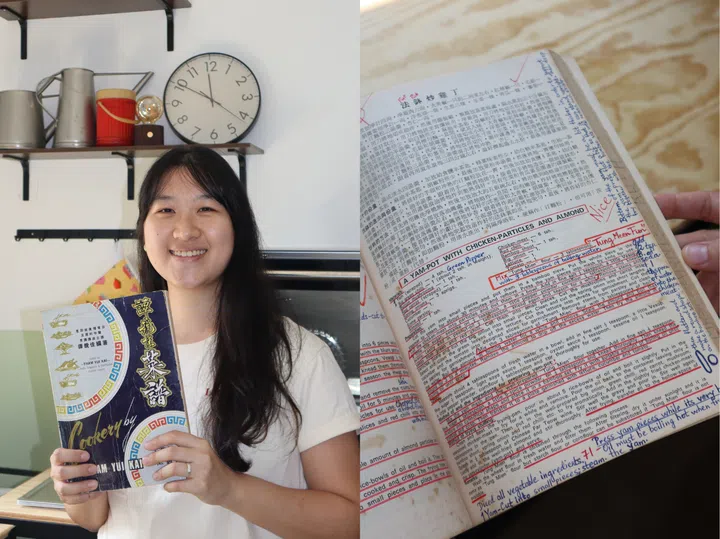
A second-hand cookbook written by legendary Cantonese chef Tham Yui Kai sits amongst the Museum of Food’s cookbook collection. This copy in particular, has cooking annotations written by its previous owner, and even one-word reviews of recipes she has tried and tested.
Emily: “I think mine would be the Kuih Kapit (love letter) moulds, mostly because of a story shared with me about it recently. It’s something that’s still purchasable but hardly seen or used in Singapore anymore. A couple of weeks ago, we hosted a participant, who actually owns this mould and uses it regularly at home. Most people don’t do that anymore in Singapore, but for him, it’s a normal practice. He told us that he and his wife still make Kuih Kapit with it all the time, over a stove at home – almost like a snack, like how we would eat fries or tacos. It made me realise that maybe a lot of these things are simpler than we think. Or at least, more doable than we assume, if we bother to do it.”
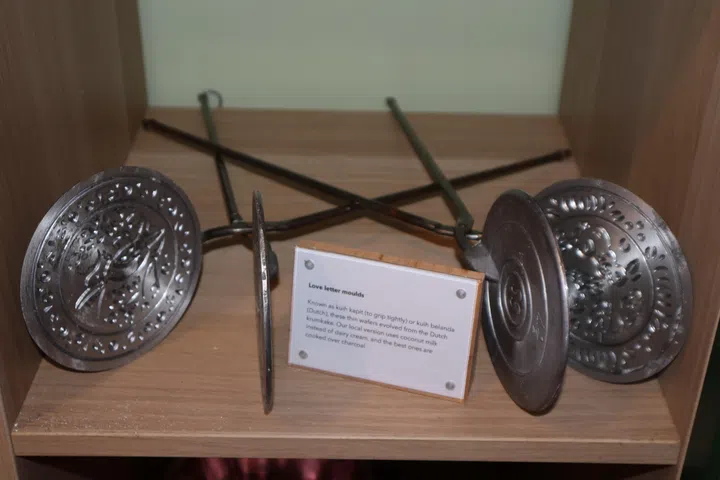
Bet you’ve not seen one of these love letter moulds in awhile. These vintage moulds feature different prints on both sides, and are commonly used to make the beloved traditional snack over charcoal.
How does the experience at the Museum of Food differ from that of a typical museum?
Emily: “We were very intentional about creating the experience. It’s not meant to be a gallery – that’s the last thing we want. Rather we wanted it to feel alive – a place where we can facilitate conversation, engage with the stories, talk about them, smell, taste, and experience them. Otherwise, it loses its meaning.”
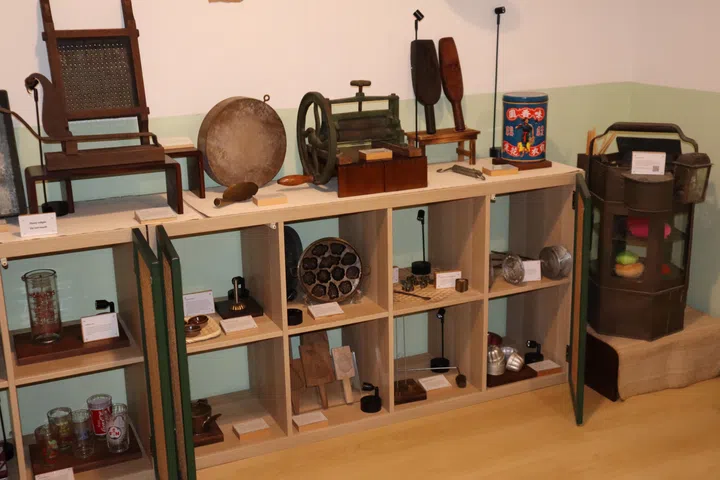
Tools on display include wooden objects that the founders encourage visitors to physically interact with.
Yeo Min: “We’re like a living experience, where you can eat, smell and touch. We’re not trying to put food behind a glass display, but trying to spotlight it and make it relevant to everyone.”
Emily: “That’s why we’re very intentional about our programming and how the space is set up. You’ll notice that everything is placed at eye level – nothing is stuck high up on a wall where you can’t touch. It’s all meant for visitors to hold and feel. For example, you can pick up the artefacts and really imagine how it would feel to use a Muruku press or even a brass or wooden tool. You can feel the weight of it in your hands. It’s another layer to the whole learning experience to be able to physically interact with the objects rather than just look at them in the glass displays.”
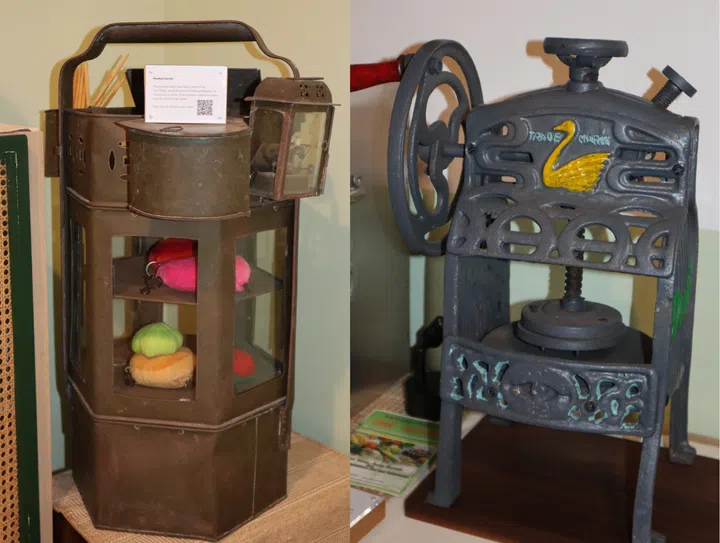
Some of the heavier items on display include a vintage hawker carrier (left) and antique ice shaving machine (right). Visitors can even try to lift the hawker carrier to feel its weight. P.S. It’s actually heavy.
Singapore’s food heritage consists of a multicultural fusion of cuisines – how does the Museum of Food ensure that all of these cultures are equally preserved and accurately represented?
Emily: “We are very careful not to represent any single culture as the dominant one. We don’t serve pork or lard, and include vegetarian options, if necessary. Our very first masterclass was also led by Audra Morrice from MasterChef – who’s Chindian – and she created an Indian-spiced takoyaki. We intentionally spotlight recipes like this to show that we are not confined to a single culture.”
Yeo Min: “We aren’t here to draw strict cultural boundaries or labels, but rather we look at Singapore’s food culture as a whole. And we see that there are actually many parallels we can draw across cultures. Tea culture is one area we can look at across all the different cultures. We just try to make sure we do not leave anyone out.”
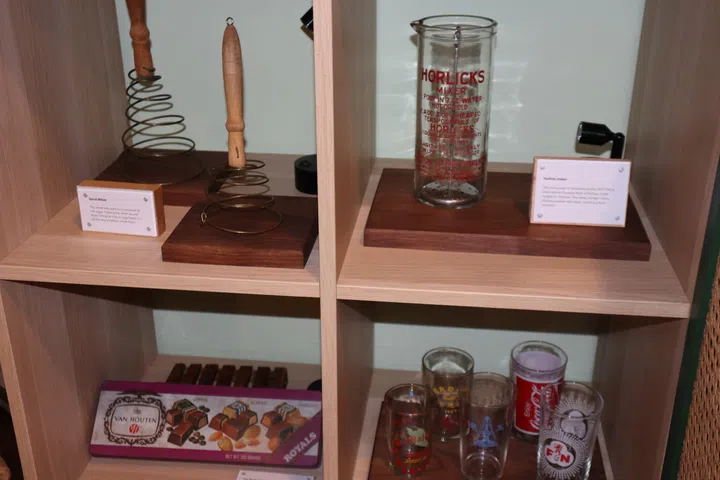
Artefact placement at the Museum of Food is meticulously curated, with those from different cultures with similar uses placed side-by-side to highlight the cross-cultural similarities in the food products we have in Singapore. Take the spiral whisk (above, left) and Horlicks maker (above, right) for example.
Emily: “In our programming, we also consider festivals and holidays. We try to curate depending on what is relevant to what is happening seasonally or culturally in Singapore – that helps inform us on what we should plan, or the kind of content we should push out.”
Yeo Min: “We also think about what is not being offered elsewhere. For example, there are festivals that fall very close together with contrasting themes, like Haji Raya Haji and Vesak Day which are less than a week apart. One involves sacrifice and meat, but the other is meant to be vegetarian. They can feel quite different, but they coexist in Singapore. So the question becomes: how do we celebrate both within the same community? So, I came up with the idea of a jackfruit rendang or something along those lines, which we are considering incorporating. We are also thinking about making halal Bak Zhang so that we’re able to cater to all, since there may not be many avenues for our Muslim friends to learn how to make it.”