
A Chat With Cecile Pesce, The Woman Behind Hermes’ Iconic Scarves
Hermes’ current creative director of women’s silk, tells us all about how the maison’s scarves continue to spark wonder today.
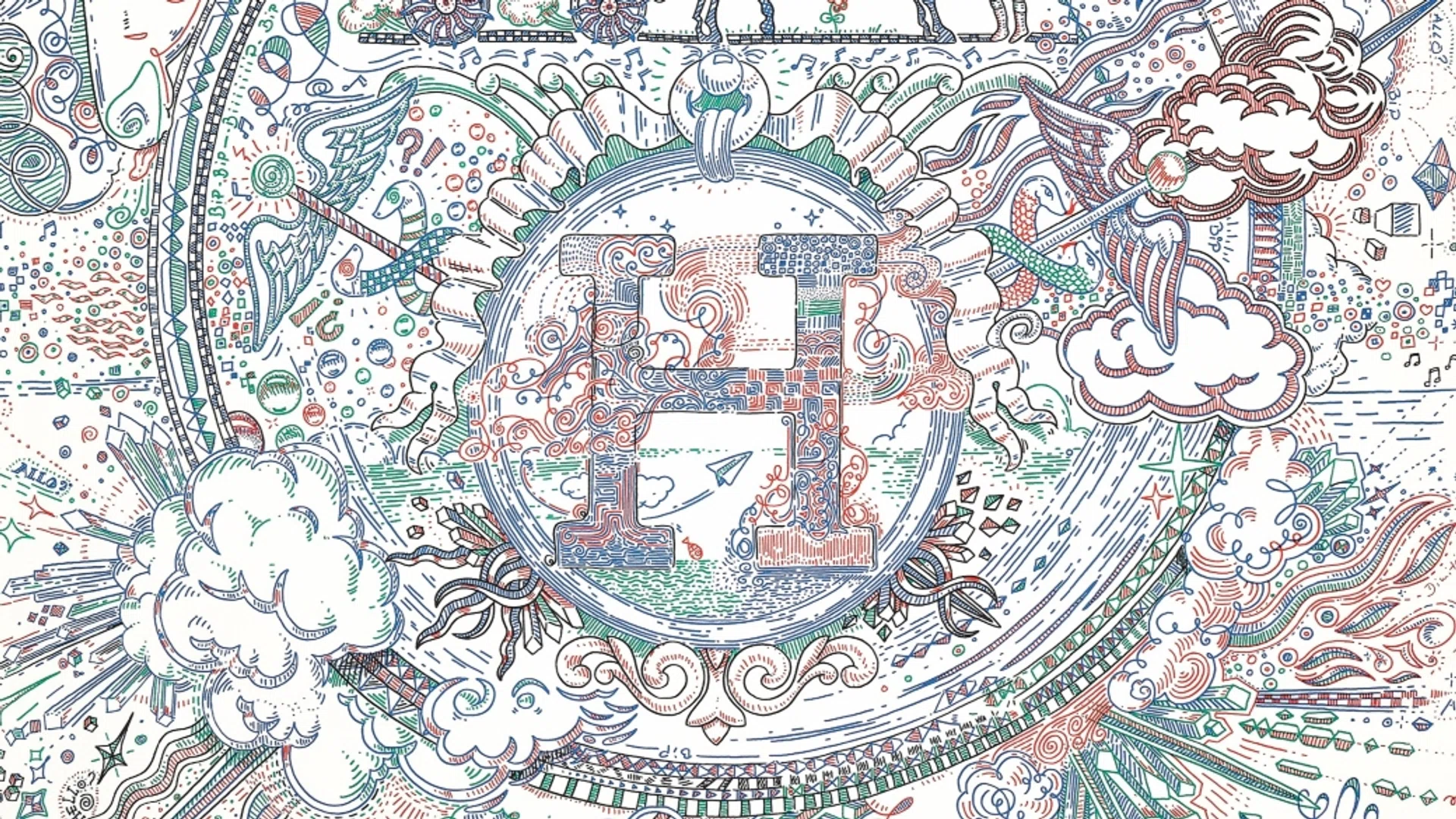
And the prize for best animated film of the year goes to… Hermes?
Those who visited The Silky Way, the exhibition by the French maison staged at Marina Bay Sands in October this year, marking its world debut, would likely agree. The highlight of the showcase – meant to spotlight the brand’s silk scarves – was a 20‑minute‑long animation that deftly integrated the rich motifs and stories of six carres (the French word for “square” and often used to refer to scarves) into a heart‑warming tale of romance and travel.
Projected across the ceiling of an enclosed circular room, with audiences viewing it while seated reclined, the production had a spellbinding effect not unlike (or even more than) some of the most celebrated cartoons of all time – Fantasia (1940) and Spirited Away (2001) come to mind. Much of the magic lay in the inventiveness and liveliness of the illustrations – a display of the six scarves (alongside others) that accompanied the pop‑up theatre proved that the film’s imagery was a faithful, moving representation of what’s found on them.
Factor in how such vibrant silks have been synonymous with the brand since it launched its first in 1937 to mark its centennial, and the message behind The Silky Way becomes even clearer: At Hermes, the design on a piece of silk comes alive – bibbidi‑bobbidi‑boo!
As the brand’s creative director of women’s silk, Cecile Pesce can be said to be the department’s figurative fairy godmother. While her background is in fashion design, she found a similar sense of, in her own words, “freedom, energy and creativity” when she joined Hermes in 2005. Her job then: work with then artistic director of the silk department, Bali Barret, to “think about the future of silks”. Her present role came under the charge of Hermes artistic director and sixth‑generation scion Pierre‑Alexis Dumas five years ago.
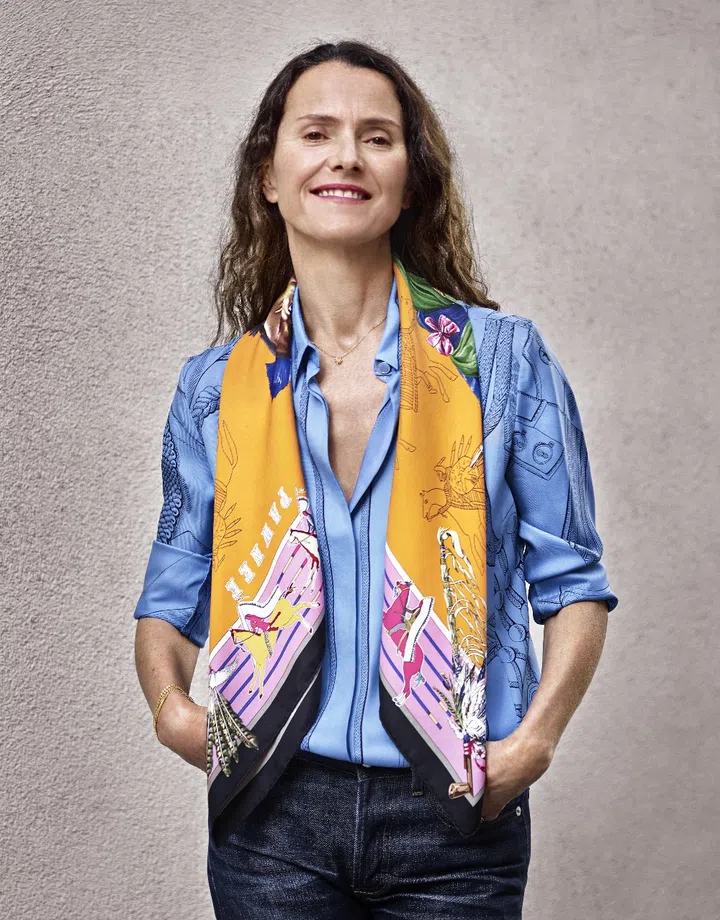
As the creative director of women’s silk at Hermes, Cecile Pesce is the department’s figurative fairy godmother. Her multi‑faceted role calls for a lot more than the simple wave of a wand, and includes finding and working with artist collaborators; breathing new life into archival releases; and choosing, from the silk workshop’s archive of more than 75,000 custom shades, the colours that go into every design. The last is a process that is as poetic as it is technical. “Colour is the second language of silks at Hermes,” she says.
“I don’t do ready‑to‑wear now, but I’m okay with this because silk is so exciting,” Pesce tells us in a video interview after The Silky Way, which featured several scarves that she had worked on, had wrapped up here.
Indeed, the silk arm at Hermes is as dynamic as the designs it produces – that very first scarf, Jeu des Omnibus et Dames Blanches, released 88 years ago helped to set the stage. Named after a board game inspired by two rival coach companies, Omnibus and Dames Blanches, that was popular at the time, it features a multicoloured woodblock print of a group of well‑dressed men and women playing said game. Surrounding this central motif are illustrations of horse‑drawn carriages belonging to the two transport carriers, and a French inscription that translates to “A good player never loses his temper” – in short, Hermes’s roots in equestrianism and play captured in a silk square.
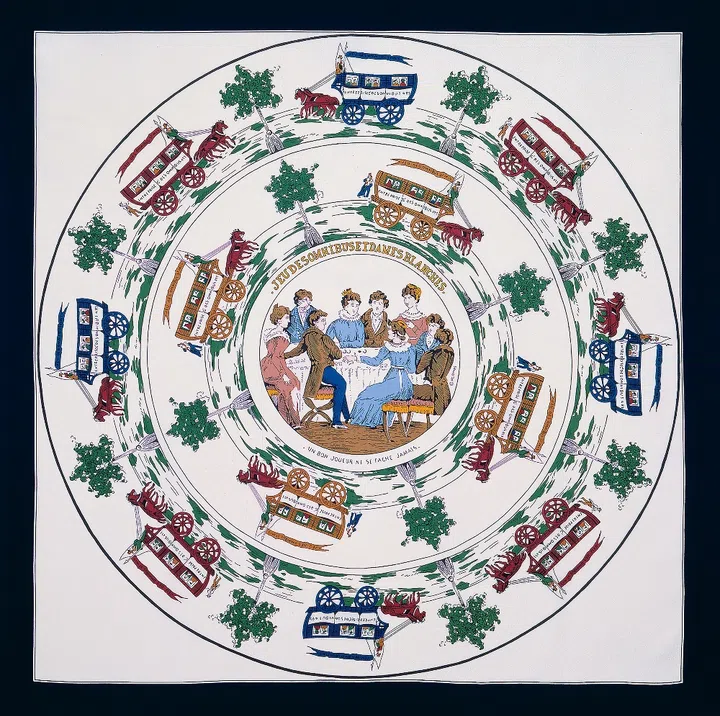
The silk that started it all: Jeu des Omnibus et Dames Blanches. Conceptualised by Robert Dumas and released in 1937 to commemorate Hermes’s 100th anniversary, this inaugural design was named after a board game inspired by two rival coach companies, Omnibus and Dames Blanches (cue the horse‑drawn carriages), and features a drawing of a group of men and women playing said game at its centre. True to the brand’s cheeky nature, it’s also inscribed with a French phrase that translates to “A good player never loses his temper”. Ingenuity, rich colour and playfulness have become hallmarks of Hermes’s silks since.
Robert Dumas – the arty son‑in‑law of third‑gen business owner Emile Hermes, and subsequently the brand’s head in 1951 – was behind the witty concept. To produce the design onto silks while maintaining the exuberance of its colours, the maison even established a dedicated factory in Lyon – historically the capital of silk in Europe – where its carres are still artisanally made.
Since then, every scarf at Hermes has been created in collaboration with an artist. “I like to say that my job is to imagine and drive different creative persons to make sure that our silk collection balances the past, present and future – that they understand the roots and spirit of Hermes while coming up with new forms of storytelling and composition,” says Pesce.
Colour has also become, as Pesce puts it, “the second language of silks at Hermes”. Every shade that the brand has concocted and applied to its silks since day one has been recorded in an archive at the Lyon workshop, resulting in a library of more than 75,000 custom colours that Pesce and team mine for new collections and inspiration. “You can express feelings and change the storytelling with the way you use colour,” says Pesce with a smile. “It’s magic.”
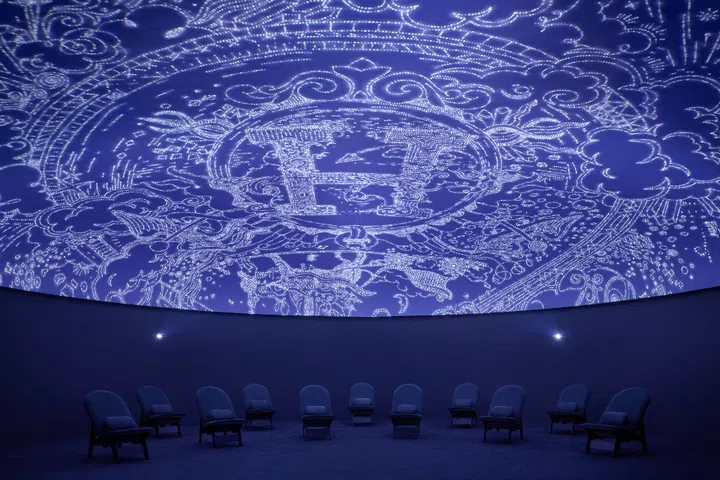
Making its world debut in Singapore in October this year, Hermes’s immersive exhibition The Silky Way showcased the liveliness of the brand’s silk designs through an animated film that was projected onto the ceiling. The humorous yet heart‑warming short featured the stories and motifs of six of the brand’s carres, including (featured here) Please Hold The Line by Dimitri Rybaltchenko, a typically four‑colour work inspired by an imaginary phone call made to the house of Hermes.
Ahead, she tells us more about what makes Hermes’s silks so fabled.
WHAT WAS YOUR FIRST MEMORY OF HERMES’S SILKS? “My first memory was of going to the archives, seeing all the scarves that have existed since 1937 and falling in love with all the designs … Yes, you can say a carre is just a piece of silk, but you can do so many things with it. For me, it’s a very sentimental object and a piece of beauty. It’s like a perfume – something that’s very close to you, and the relationship you have with it is very intimate. Because of the fabric, the colours and the savoir faire that goes into every piece here at Hermes, I was getting new ideas every minute while in the archives. I was so excited by the subject: to be able to choose the storytelling, and the designer or artist we’d work with; to imagine the colours we’d use as well as new innovations such as new ways of embroidery, and playing with the silk and dyes. Here, we try lots of different things.”
WHAT WOULD YOU SAY MAKES AN HERMES CARRE UNIQUELY HERMES?
“First, there is the savoir faire: the silk, the screen print, the brightness of the silk (Hermes sources its silk from Brazil, known for its exceptional quality, while all the processes at its Lyon workshop call for the human eye and hand, from transferring a design onto a piece of silk to silkscreen printing each colour layer by layer to hand‑rolling and ‑stitching the carre hems). I think we have the best designers because we want excellence, and we have lots of colours on one scarf (on average, an Hermes carre has around 30 different colours in its design, but this can go up to 49). We’re the only house in the world that creates scarves like this. And the biggest difference is that we’re the only house to have such a huge and independent collection of scarves – we’re not linked to the ready‑to‑wear collection, so ours is really a standalone collection with many different formats, ways of storytelling and colours.”
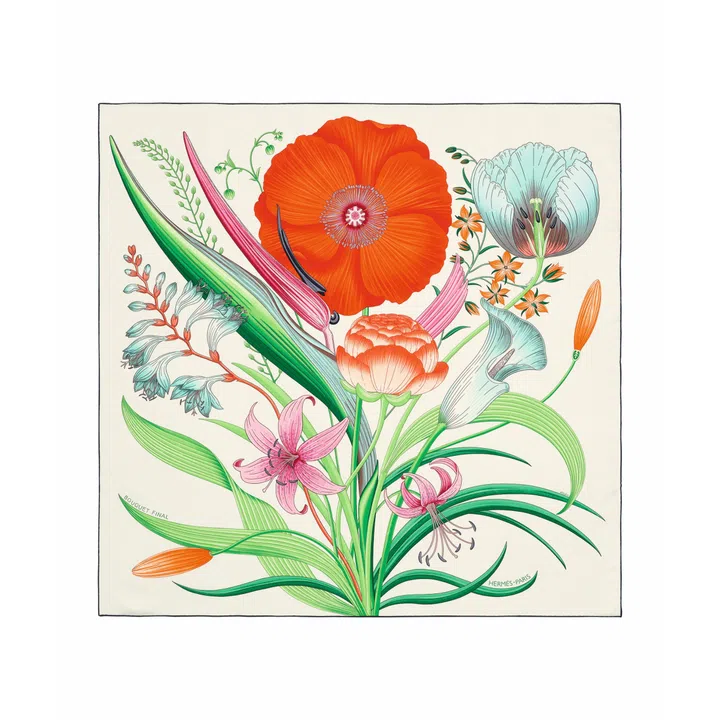
The story of each Hermes silk is often influenced by the brand’s theme of the year. To celebrate the theme for 2025, Drawn To Craft, Pesce and team made it a point to tap on a diverse range of drawing styles. Among the results: Bouquet Final, a graphic, watercolour‑esque drawing of a bouquet of flowers by London‑based illustrator Katie Scott.
HOW DO YOU GO ABOUT CHOOSING THE ARTIST OR DESIGNER TO WORK WITH ON A SILK DESIGN?
“The first meeting between us is so important because it allows us to see and understand if the collaboration will be a good one. It’s like a marriage, you know, and in the end, you hope you’ll produce a nice baby because it’s really difficult to make a carre. You can be a very famous or talented artist, but to do a carre is another story. You have to be able to understand the Hermes spirit and identity, and you have to be able to think and express yourself in a square. If you think about our by 90 cm), for example, it’s huge and you’d have to think about the composition, the border, and how there should be a different design element at every corner (another distinguishing factor of most Hermes scarves). It’s like writing a book or composing music … It’s a really specific exercise.”
HAS COMPOSING A SILK DESIGN FOR HERMES CHANGED OVER THE YEARS?
“In the past, we used to work within a frame. We’ve also had lots of storytelling composed within a circle. For a few years now though, we’ve approached the design of our silks more like a picture – it’s really different because it’s another way to tell a story. We’ve also been showing new designers the archives and how we used to compose silks in the past, and then letting them adapt and create based on their own feelings and way of expression. What’s also important is choosing the story to be told on a piece of silk. Often, this is influenced by the theme of the year.”
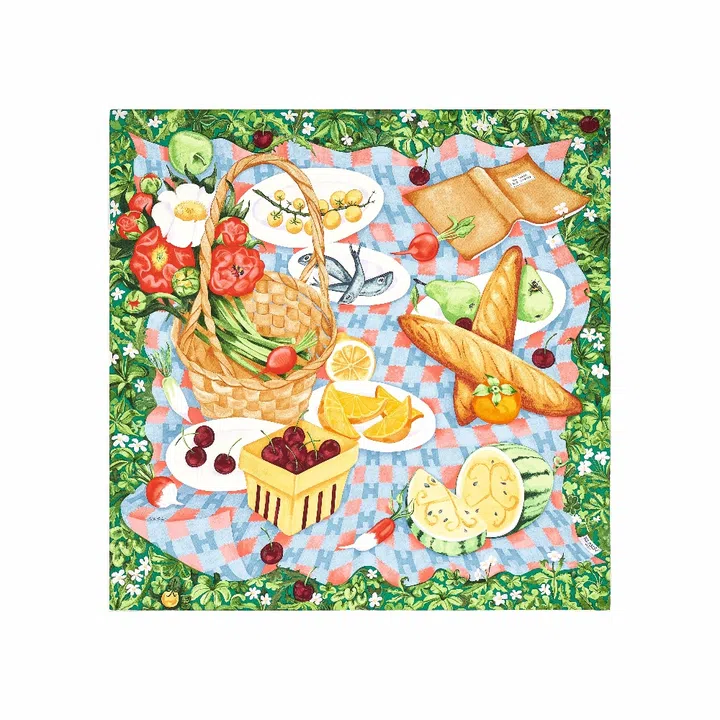
Another silk created in celebration of Hermes’ 2025 theme, Drawn To Craft: Un Carre sur l’Herbe, an oil painting of a picnic spread by American artist Nikki Maloof, and a technical feat to recreate onto silk.
HERMES’S THEME FOR 2025 IS “DRAWN TO CRAFT”, WHICH CELEBRATES THE ART OF DRAWING AND HOW IT’S THE STARTING POINT OF EVERYTHING AT THE MAISON. IT MUST HAVE BEEN INTERESTING FOR YOU, CONSIDERING HOW ILLUSTRATION LIES AT THE HEART OF EVERY SILK.
“It was a very difficult theme for us because drawing is always our subject here, but we’ve tried to put into this year’s collections different ways of drawing – pencil, ink, patchwork, et cetera – and to make sure each carre is really different, and puts the spotlight on the design and designer behind it. For example, we have Please Hold The Line by Dimitri Rybaltchenko, who worked with just four colours to emulate what happens when one is placed on hold while on the phone and given a notepad to doodle on without thinking. This, I’d say, is quite an emblematic design for us. (The intricate sketch is wildly imaginative and humorous, and anchored by Hermes’s logo in the centre, suggesting that the call is directed to the maison.) At the same time, we have Bouquet Final – a drawing of a big bouquet of flowers that’s very impactful (behind it is the London‑based illustrator Katie Scott, who’s known for her watercolour‑esque depictions of nature). And we also have Un Carré sur l’Herbe, which was very challenging to reproduce onto silk accurately because it’s based on an oil painting (the colourful work featuring a picnic spread is by the expressive young American painter Nikki Maloof). With these three examples, you can see the way we work with the annual theme.”
OUT OF CURIOSITY, HOW LONG ON AVERAGE DOES IT TAKE FOR A SILK TO BE PRODUCED – FROM THE INCEPTION OF THE DESIGN TO SEEING IT IN STORES?
“Usually, it takes around two years between the first meeting and the result, and only after that does it go into a collection. It’s a long, long way for a new artist to see his or her own work in the shop … In the end, I want both the artist and us to be satisfied by the result. It’s a baby, after all, so it affects both parties.”
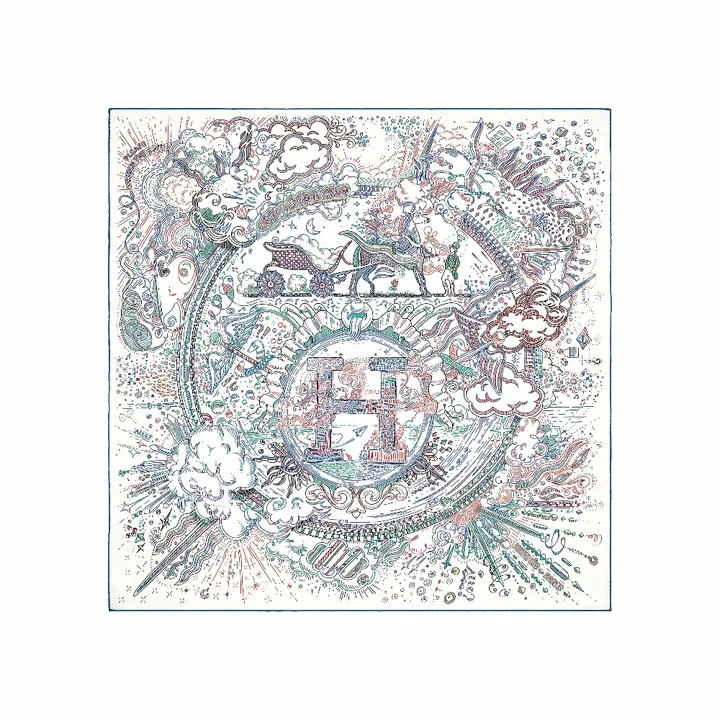
Another silk created in celebration of Hermes’ 2025 theme, Drawn To Craft: Please Hold The Line by Dimitri Rybaltchenko. It’s a wildly complex sketch inspired by the idea of doodling while waiting on the line, and a fine example of the imaginativeness and deft use of colour synonymous with Hermes silks.
IT MUST BE BOTH FUN AND CHALLENGING TO HAVE SUCH A HUGE LIBRARY OF COLOURS TO WORK WITH.
“We have a lot of colours because we’ve been collecting them since 1937. When I start a collection (she creates two each year), I usually imagine and come up with five colour stories or themes that reflect the present. After all, each period in time tends to have a specific way in which colour is used – the 1980s, for example, is associated with lots of black and bright colours. I’ll then play with these five colour stories and end up needing lots of colours because we have so many different designs, and I have to be able to choose the exact shade that’s suitable … It’s important to know that people remember colour more than the design. Sometimes, when someone tells me they have a new scarf and I ask them about its design, they aren’t able to recall it, but they’re usually able to tell me what the colour is. The storytelling of a silk can become really different depending on its colours.”
WHAT’S YOUR ADVICE TO A YOUNG PERSON THINKING OF BUYING HER FIRST SILK?
“My advice is to be completely free and to not be intimidated … You have to be clear about what you want, and this makes it important for you to try and touch and see lots of different formats and designs, whether they’re archival or new … The carre 90 is considered iconic while the carre 70 (which measures approximately 70 cm by 70 cm) is sometimes considered easier to wear, as it’s smaller and its colours tend to be more playful. There’s also the bandana – a small piece with just two to three tones, so it’s easy to match and could make a great first piece. It really all depends on what you want. There’s really no good or bad way to wear a scarf.”
THIS INTERVIEW HAS BEEN EDITED FOR BREVITY AND CLARITY.
This article first appeared in Volume 5 of F Zine.